|
1
|
- Presented by Deborah Danila
- On December 21, 2006
|
|
2
|
|
|
3
|
|
|
4
|
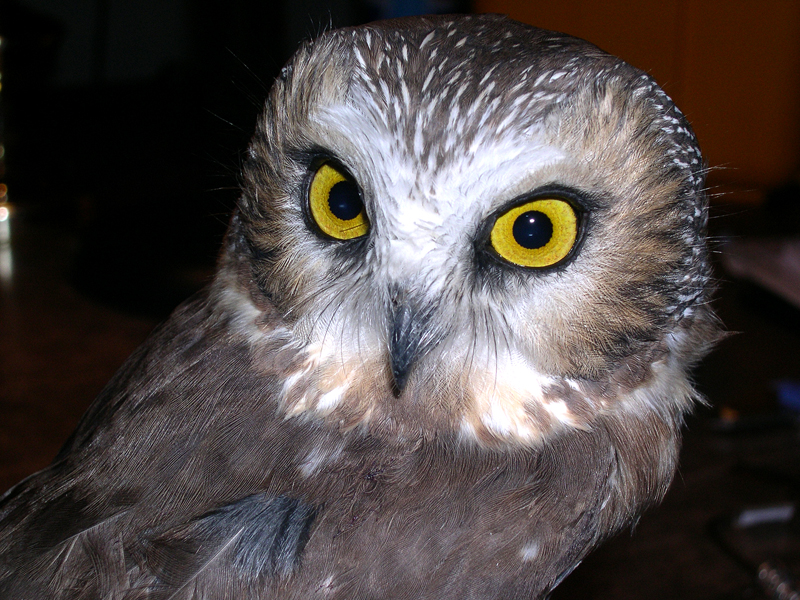
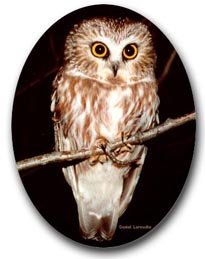
- Saw-Whets are both migratory and nomadic
- Show little faithfulness to nesting sites and select instead
an area with a high vole population (same for wintering site?)
- NSWO are present year-round on their breeding range
- Many (not all) move south in Autumn (irruptive migrant)
- There is a large fluctuation in the number of individuals migrating
each year:
- Our seasonal totals have ranged from 727 in 1999 to 23 in 1997
with a 10 year average of 366
- Could be result of the degree of breeding success, but
- Many adults migrate, so breeding success alone cannot explain
the irruptive nature of NSWO migration
|
|
5
|
- Migration may also be affected by variation in the degree of competition
for seasonally available resources (food, habitat, perch sites)
- More owls (good breeding success) and/or fewer resources (fluctuation
in population of prey species)
- NSWO are small-bodied, with high mass-specific metabolic costs
- They migrate using powered, flapping flight, and
- They don’t tend to build up huge fat reserves like long-distance
migrants
- Must continue to hunt during migration which, as a result, may
progress at a more leisurely pace
- There’s competition for resources at stopovers during migration,
too
|
|
6
|
- A larger number of owls migrate
- Dominated by Hatch Year birds
- Body mass and body-condition indexes significantly lower for all
owls, and particularly for immature owls – evidence of competition
for the available resources
- Low-Recapture Rate: A smaller number of owls elect to stopover
- Population of prey species along the migration route can diminish
quickly, and the owls in good condition move on sooner “…minimizing
length of stopover to the extent that energetic condition allows.”
|
|
7
|
- Dominated by Adult birds
- Recapture rates 3x higher
- Significantly higher
for Adults in good condition
- Stopovers twice as long
- When there is less competition, more experienced adults in good
condition seem better able to establish residency along the migration
route, and
- Immature owls and those in poor condition must move on when they
can.
|
|
8
|
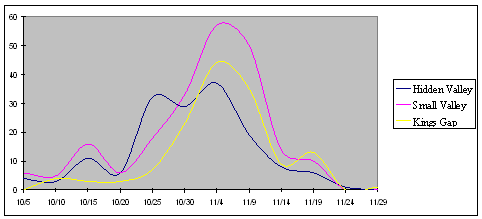
- Early reports from the north suggested the owls were late, but
coming in above-average numbers.
- Banding site along the St. Lawrence in Quebec captured 27 saw-whets
in their first two weeks (after netting only 28 total all of last
season) and reported their highest total count since 1999 (128).
- Ottawa set new record: 30 in one night
- WhiteFish Point Bird Observatory in Paradise, Michigan, reported
a ‘Spectacular Season!’ with all-time high of 325 Saw-whets
- Minnesota bander, captured over 500 owls working on his own, including
one night of almost 80.
- In parts of the upper Great Lakes, there is a tremendous amount
of habitat to the north, and the funneling effect of the lakes,
can channel the birds through certain areas.
- Linwood Springs,Wisconsin, reported an all-time high of 77 saw-whets
on one night, breaking a decade-old record of 71 birds.
|
|
9
|
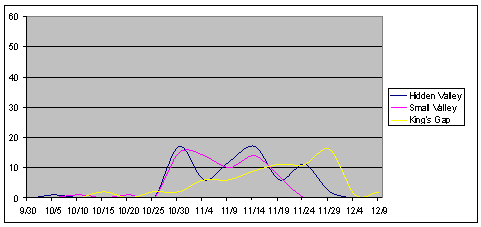
- Things were ‘miserably slow in western Maryland’
- SkyTop in NE Penna claimed ‘worst season ever’
- There was A LOT of reading, and napping, and card-playing and
general twiddling of fingers at Hidden Valley, PA
- On 11/3 West Chester NY had only 3 owls, compared to 26 last year
at that same time
- Greene County Indiana had the “Slowest season so far” (18)
- WoodRiver NE, with a total of 11, reported ‘very poor capture
rate’
- Western VA reported only 61 for the season, less than half of
total in past two years
- This year’s migration appears simply to have stopped for most
of the saw-whets somewhere north of our banding sites
- Migration is essentially about finding food, and
- Perhaps mild weather, and high prey populations in the north kept
the owls out of reach this year (several banders reported more birds
with above-average weights)
|
|
10
|
- According to the annual predictions of Ron Pittaway (of the Ontario
Field Naturalists): “The widespread abundance of seeds, berries,
nuts and fruits (mast) is providing a huge food supply for small
mammals such as voles, so their numbers should be increasing. Most
boreal forest owls (Northern Hawk Owl, Great Gray Owl, Boreal Owl)
likely will stay close to breeding territories this winter. Increasing
numbers of small mammals will increase owl breeding success next
spring and summer.”
- BUT will they come south??
- In the eternally optimistic view of Scott Weidensaul:
- “…his observation regarding vole populations bodes very, very
well for next year, especially considering the large number of young
saw-whets being reported at northern banding stations this season.
A well-provisioned female saw-whet may lay up to 11 eggs, which
means 2007 may be the kind of major invasion year we haven't seen
since 1995 and '99. We'll keep our fingers crossed...”
|
|
11
|
- Whoo Am I?
- Shadow in the trees.
Wisp in the night.
Clearly he sees, without any light.
Chameleon by day.
Killer by night.
Stalking his prey, in the pale moonlight.
- By: Daryl Aspery
- “Migratory birds do, in the end, integrate and reflect environmental
change on the broadest of scales.
The sobering truth is that whether future generations can
enjoy this truly remarkable phenomenon of nature will be more a
measure of whether humanity will have achieved sustainable development
than anything else.”
- - Dr. Thomas E. Lovejoy
|
|
12
|
- Annual migration density and stopover patterns of Northern Saw-whet
Owls (Aegolius acadicus) Auk,The, Oct 2002 by Whalen, David M, Watts,
Bryan D
- Daily Email Updates from Scott Weidensaul
- Reports on SawWhetNet listserve
- Atlas of Bird Migration – Tracing the Great Journeys of the Worlds’
Birds – General Editor Jonathan Elphick
- Living On The Wind, Scott Weidensaul
|

 Notes
Notes