 CONSERVATION CORNER 2008
Click Here for information on this image
DVOC Main Page
> Conservation > Conservation Corner
2008
CONSERVATION CORNER 2008
On this Page.......................
Cherry Vallley NWR
Banded Birds
Watching Wildlife
Decline in Birds
Boreal Forests
Bird Migration Safety
NJ Red Knot Law
Merritt Island
Funding for Wetlands Habitat
Red Knot Legislation Moves Forward
Red Knot Legislation Update (Hope for Red Knots)
2007 Conservation Award
Red Knots Remain Imperiled
Brown Pelicans Rebound
Important Bird Areas
Purchase DVOC Merchandise to benefit the DVOC Conservation
Fund - Click here!
Purchase Nikon/DVOC Merchandise to benefit the DVOC Conservation Fund - Click
here!
 Conservation Corner - a running list of issues of interest to our members
NEW
NATIONAL WILDLIFE APPROVED FOR EASTERN PA
(DVOC Conservation report, December 24, 2008)
U.S. FISH & WILDLIFE PRESS RELEASE, December 23, 2008:
The U.S. Fish and Wildlife Service today approved the establishment of Cherry
Valley National Wildlife Refuge in eastern Pennsylvania. The Service has established
a boundary for the refuge, encompassing 20,466 acres in Monroe and Northampton
counties, within which it may begin acquiring nationally significant habitat
for wildlife as part of the National Wildlife Refuge System.
"It is a great honor, as Secretary of the Interior, to be able to recognize the establishment of this new National Wildlife Refuge," Secretary of the Interior Dirk Kempthorne said. "The Department of the Interior and the U.S. Fish and Wildlife Service are committed to the protection and conservation of the environmental diversity of this country. This new refuge will allow us to further our mission as we work to ensure that generations of Americans long into the future still will benefit from the abundance of our nation's natural beauty."
Cherry Valley National Wildlife Refuge encompasses rare ecosystems, several plants and animals protected under the Endangered Species Act, and numerous species of concern within the conservation community. Cherry Creek, in the bottom of the valley, ultimately flows into the Delaware River. Following the creek's path, Kittatinny Ridge is a major avenue for migrating birds and bats.
"The partnership approach to the planning for the Cherry Valley National Wildlife Refuge is a model for future planning efforts," said Fish and Wildlife Service Director H. Dale Hall. "The collaboration of officials from local, state, and federal offices, as well as non-governmental organizations made sure the process was efficient and comprehensive. The strong, grassroots support for the project shows that this habitat is nationally significant and Cherry Valley is the right place for a new national wildlife refuge." Hall said the agency accomplishes much of its fish and wildlife conservation mission by strategically acquiring and managing lands as part of the National Wildlife Refuge System.
At Cherry Valley, the Service's next step is to work with partners and landowners within the refuge boundary to identify opportunities to acquire lands through easements and fee title. A number of organizations, including the Commonwealth of Pennsylvania, The Nature Conservancy, National Park Service and other entities already protect a significant amount of conservation land within and near the new refuge boundary. The Service will work to provide opportunities for wildlife-related recreation--such as hunting, fishing and bird watching--and ensure these activities are compatible with the management goals and mission of the refuge.
The announcement culminates a movement begun in 2005 when U.S. Representatives Paul E. Kanjorski (Penn.-D-11th) and Charles W. Dent (Penn.-R-15th) co-sponsored a bill on behalf of their constituents to consider a prospective national wildlife refuge within Cherry Valley. The legislation was in response to a petition advocating refuge establishment endorsed by community leaders and local elected officials in Monroe County. The 109th U.S. Congress approved the Cherry Valley National Wildlife Refuge Study Act in 2006. The study and an environmental assessment required under the National Environmental Policy Act were completed earlier this month, and the Service's Northeast Region recommended establishment of the refuge boundary.
The completed study, which includes the final environmental assessment, finding of no significant impact (FONSI) and other establishing documents, as well as answers to frequently asked questions regarding establishing national wildlife refuges, can be found online at http://www.fws.gov/northeast/
The Service completed the Cherry Valley study in partnership with The Nature Conservancy and many other organizations, including the Pennsylvania Fish and Boat Commission, Pennsylvania Game Commission, National Park Service, Monroe County Planning Commission, Monroe County Conservation District, Northampton Community College, East Stroudsburg University and the Pocono Avian Research Center.
The mission of the U.S. Fish and Wildlife Service is
working with others to conserve, protect and enhance fish, wildlife, plants
and their habitats for the continuing benefit of the American people. We are
both a leader and trusted partner in fish and wildlife conservation, known for
our scientific excellence, stewardship of lands and natural resources, dedicated
professionals and commitment to public service. For more information on our
work and the people who make it happen, visit www.fws.gov.
Report Banded Birds this
Winter
(by Debbie Beer, DVOC Conservation Chairperson, December
7, 2008)
© A Binns
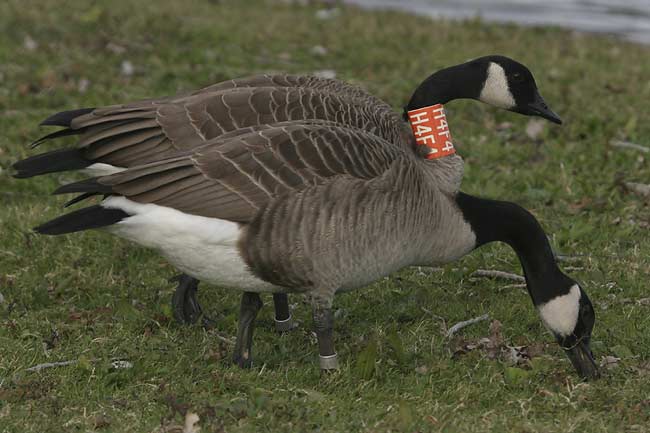
A fascinating art and science, bird banding reaches back centuries, from when kings and falconers tagged their hunting birds, and the curious-minded marked their backyard regulars to see if the same individuals returned year after year. Today, licensed banders participate in a formalized system, employing advanced techniques to collect a wealth of information, and distribute data internationally. Through the ages, bird banding spawns perhaps as many questions as it seeks to answer.
Currently, bird banding programs stretch from the Canadian Arctic to the tropics of Latin America, from Newfoundland to the far Pacific islands, and beyond to places like Siberia, Greenland, and Antarctica. Wherever birds go, bird banding is there, especially in North America, but also across the globe.
Virtually all species are, or have been, banded. An estimated 1.2 million birds are currently banded, with roughly 7% recovered each year. The majority of recoveries occur in ducks and geese, mostly by hunters who take the birds and return the bands. Recovery rates are very low for non-game birds, like warblers, vireos, hawks, owls, shorebirds, gulls and waders. Today’s banders use a variety of methods to capture birds, band or color-mark them, take body measurements, and extract blood and feather samples for analysis. Some even use radio-telemetry to track birds in the wild, discovering fascinating new information about bird behavior.
Currently, more than 6,100 banders are operating in US and Canada, including federal and state conservation agencies, university associates, ornithologists, environmental centers, nongovernmental organizations, and other businesses.
The earliest banding focused on migration, seeking to answer the age-old question of “where did they come from?” and “where are they going?” Currently, bird banding data is useful in both research and management projects. Identification of individual birds allows for study of bird distribution and migration, as well as behavior, social structure, life-span and survival rate, population growth, disease and safety. Data from banding is significant for policy decisions regarding the environment and avian conservation issues.
The North American Bird Banding Program is facilited by the U.S. Department of the Interior and the Canadian Wildlife Service, jointly coordinating efforts since 1923. Their respective banding offices employ similar policies and use the same bands, reporting forms and data formats. Data is collected by the Bird Banding Laboratory (BBL).
While a relatively small percentage of birders are licensed banders, more participate by assisting banders with data collection, equipment set-up, and educational outreach. One of the best ways to get involved is to REPORT BAND SIGHTINGS! Winter is a great time to take note of numbered neck collars worn by Canada Geese and Snow Geese, or any other banded species you might be lucky to spot. Large numbers of geese congregate at Brigantine and Bombay Hook refuges, as well as in local fields and ponds. As we birders are often scanning these flocks for rarities, it is possible to see several individuals wearing yellow or red “neckties.”
Reporting banded birds couldn’t be easier. It
takes less than 5 minutes to log onto the website: http://www.pwrc.usgs.gov/bbl/,
click on “Report a Bird Band” and follow the instructions. You need
only to know the species, date and location (including county), and provide
basic contact information for yourself. You’ll always be acknowledged,
though it may take a long time, as they receive thousands of reports each year.
You may even get a certificate of information about your individual bird! Results
from banding studies support important national and international conservation
programs such as the North American Waterfowl Management Plan, and Partners
in Flight.
Watching
Wildlife Enhances Economy!
(DVOC Conservation report, by Debbie
Beer, October 16, 2008)
© A Binns
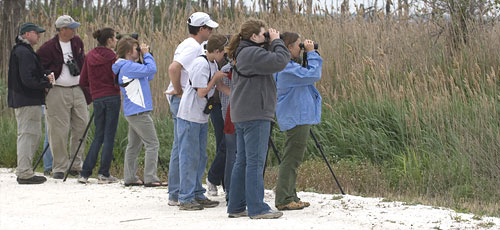
U.S. Fish and Wildlife Service released a detailed report this month highlighting how wildlife watching is a significant contributor to national and state economies. This comes as no surprise, thinking of how much money birders spend on early-morning Wawa stops, in addition to expenditures on binoculars, spotting scopes, cameras, tripods, bird seed, gas, hotel rooms and meals.
According to this report, nearly 71 million Americans (16 years of age and older) spent more than $45 billion observing, feeding, and photographing wildlife in 2006. Wildlife watching expenditures generated nearly $123 billion in total industrial output, resulting in more than 1 million jobs and $9.3 billion in federal tax revenue. These figures are equal to the revenues from all spectator sports, amusement parks and arcades, non-hotel casinos, bowling centers and skiing facilities combined! The top 5 U.S. states ranked by economic output include some of our favorite birding destinations: California, Florida, Texas, Georgia and New York.
All of this data underscores the economic power of birders
engaged in our passionate hobby. Wildlife watching not only contributes to people’s
enjoyment of our natural environment, but plays an important role in our national
economy. This is an important fact considering that major decisions affecting
wildlife and conservation are driven by money, not altruism. The taxes alone
we’re generating must be helping to fund the federal government bailout
of banks and mortgage lenders!
Common
Birds in Decline Internationally
(DVOC Conservation report, by Debbie
Beer, October 2, 2008)
© A Binns
In summer 2007, the National Audubon Society released a benchmark report, “Common Birds in Decline.” The report confirmed the popular belief that birds are indeed more scarce than they were decades ago in North America.
Not surprisingly, this documented decline is not limited to North America. A new BirdLife International report released September 22, 2008, “State of the World’s Birds,” reveals similar precipitous declines in populations of many of the world’s most familiar birds. Audubon Bird Conservation Director, Dr. Greg Butcher commented, “As we found in 2007, this report points out the increasing impact of large-scale environmental problems such as global warming, along with the continuing toll from weak conservation policies at home.” He reiterated that habitat loss remains a leading cause for concern internationally.
The BirdLife report highlights staggering avian losses worldwide, including 45% of common European birds in decline, and Australian wading bird species suffering population losses of 81% in just 25 years. In Latin America, the Yellow Cardinal – once common in Argentina – is now classified as Globally Endangered. The millions of White-rumped Vultures that recently flew in Asian skies have been reduced by 99.9% in just sixteen years; the species is now classified as Critically Endangered. Widespread birds like the Eurasian Eagle Owl are vanishing from Middle Eastern forests, and seabirds like nearly all of the 22 species of Albatross are disappearing at an alarming rate from the world’s oceans.
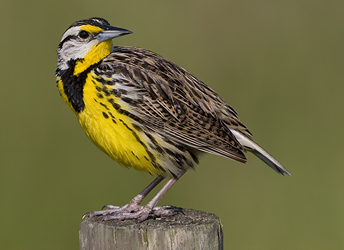
Recall that the North American report profiled 20 birds with the greatest population declines since 1967, with the average decline being 68%, from 17.6 million to 5.35 million. Northern Bobwhite topped the list with 82% population decline in forty years. They, along with Meadowlarks (down 72%), Field Sparrows (down 68%) and other grassland species, cannot endure the vast amounts of grassland being lost each year to suburban sprawl, industrial development, and intensified farming. Greater Scaup (down 75%) are succumbing to dramatic changes in their tundra breeding habitat, which is transforming with global warming. Evening Grosbeaks (down 78%) and Boreal Chickadees (down 73%) face deforestation from insect outbreaks, logging, drilling and mining.
Population data for both the recent BirdLife Report and Audubon’s Common Birds in Decline report included vital data compiled from the long-running, citizen-science based Christmas Bird Count. Ordinary people contribute extraordinary information to a very important conservation effort, becoming part of the solution.
The good news is that the alarming trend of decline can be
reversed with commitment and relatively small amounts of money. “Effective
biodiversity conservation is easily affordable, requiring relatively trivial
sums at the scale of the global economy,” said Dr. Mike Rands, CEO of
BirdLife International. By some estimates, safeguarding 90 percent of Africa’s
biodiversity would cost less than $1 billion US dollars a year. Dr. Rand urges,
“The challenge is to harness international biodiversity commitments and
ensure that concrete actions are taken — now!”
One of the most important messages from both reports is that people can –
and do – make a difference. Average citizens can change the fate of imperiled
birds with actions large and small. I personally believe that our lives are
intricately entwined, and every action taken, or not taken, is subject to the
ripple-effect of direct or indirect influence on others. Imagine the impact
if every single household backyard offered food, shelter and places for birds
to raise young. Think of the birds we’d please!
For more information about this report, click on the
BirdLife International website: http://www.birdlife.org/news/pr/2008/09/SOWB_global.html
Boreal
Forests under Pressure
(DVOC Conservation report, by Debbie
Beer, May 1, 2008)
© A Binns
Information from National Audubon Society website:
Imagine a wetland-rich forest teeming with wildlife and billions of colorful songbirds, ducks, and shorebirds. This description might conjure up images of the Everglades or the Amazon Rainforest.
In reality, it describes a forest ecosystem in northern Canada and Alaska called the boreal forest. Stretching from Alaska to the Atlantic Ocean, North America’s Boreal Forest is one of the world’s largest intact forests. It accounts for 25% of the earth’s remaining forests, covers 1.4 billion acres, and is larger that the Brazilian Amazon. North America’s Boreal Forest supports some of the largest populations of wildlife such as grizzly bears, Woodland Caribou and wolves, and provides vital breeding grounds for up to a third of North America’s land birds (up to a billion warblers and 500 million or more sparrows) and 40% of its waterfowl.
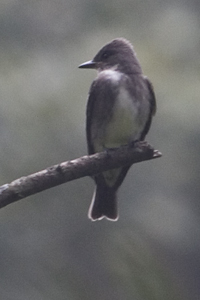
Boreal-breeding birds include many Audubon WatchList species, such as Canada and Bay-breasted Warblers, Olive-sided Flycatcher, and Rusty Blackbird. More than 300 bird species regularly breed in the boreal forest. Eighty species have 50% or more of their Western Hemisphere breeding range and breeding population in the boreal.
Many of the birds that spend their summer breeding in the boreal forest are Neotropical migrants that spend the winter in the Southern U.S., Mexico, the West Indies, or Central or South America. To see a map of this migration, click here. These Neotropical-wintering, Boreal-breeding migrants pass through the United States in large numbers in both spring and fall and provide the highlights of the birding year for many U.S. birdwatchers. Other boreal-breeding birds spend the winter in the United States and are among the most common species found on Audubon’s Christmas Bird Counts.
While much of the boreal region remains unspoiled at this point, development is rapidly escalating; oil and gas, mining, logging, and hydroelectric development are pushing northwards at increasing rates. Land-use decisions will determine the fate of much of the boreal region within the next five years.
You can make a difference in the future of this precious ecosystem. First, reduce use of paper catalogs by shopping on-line, cancelling unwanted magazine subscriptions, and not printing every email (read them online instead). Second, encourage companies to print marketing and sales materials on recycled paper from renewable forests. Kimberly-Clark, one of the largest disposable paper products companies in the world (Kleenex, Scott, Cottonelle, could have a huge impact on boreal forests by adjusting their production practices
To learn more about Audubon's efforts to protect the
boreal forest and boreal forest birds, go to http://www.audubon.org/campaign/overview.html
or www.borealbirds.org.
BIRD
MIGRATION SAFETY
(DVOC Conservation report, by Debbie
Beer, April 5, 2008)

© A Binns
For us birders in the northeast, Spring is finally here. Reports of “early migrants” are trickling in, building keen anticipation of warblers, vireos, thrushes, shorebirds and many exciting species. The amazing phenomenon of bird migration peaks each year from March to June, as birds of every kind make their way from their winter homes in the south to their summer breeding grounds in places as far north as the Arctic.
Migration journeys are filled with peril, as birds encounter exhaustion, storms, and limited food supplies. In addition to these “natural” threats, they are further challenged by human obstacles such as bright lights, tall structures, domestic pet predators and toxic lawns.
Fortunately, people can help make safer journeys for migrating birds. Backyards and parks, often key stopover points for many species, can serve as important bird-friendly rest stops with a few simple steps. National Audubon Society urges people to take the following actions this Spring, during peak migration months April-June:
• Turn off lights at night: Birds become disoriented by artificial light, which often results in fatal collisions with buildings, homes, and other structures. To minimize this, turn off exterior and interior lights as much as possible each night. Outfit exterior lights with top and side shields to direct the light downward. If you work in a high-rise, advocate for "lights out" during migration season.
• Prevent window collisions: Many birds strike windows after being startled off a feeder, seeing escape routes mirrored in reflective glass. To avoid this, reduce reflectivity with drapes or blinds, and stick decals on the outside of windows. You can also place netting or a screen in front of the window. Bird feeders should be either very close (within 3 feet), or farther away (more than 30 feet) of windows.
• Keep cats indoors: It is estimated that cats kill more than a billion birds each year. Keeping cats indoors helps keep the birds outdoors safe, and it also reduces risks to cats, especially from injuries and disease.
• Eliminate pesticides: U.S. households use 110 million pounds of pesticides in their homes and gardens annually, which kill several million birds each year when the birds ingest tainted insects, seeds and other food sources. Use the least toxic alternatives for combating pests.
• Keep feeders stocked and clean: Birds need rest and fuel during migration. Backyards serve them well with native plants, supplemented with well-stocked birdfeeders. Along with native plants and feeders, provide a source of fresh water for the thirsty travelers. Adding a drip to a bird bath or pool greatly increases its attractiveness to migratory birds as it adds noise and movement. Reduce the risk of spreading disease at feeders by regularly cleaning them with a nine-to-one water-bleach solution, or a dilute vinegar solution (three-to-one) or non-fragranced biodegradable soap.
For more information on how to keep birds safe, visit the Audubon At Home website at www.audubonathome.org (go to the "Keeping Wildlife Safe" link on the left-hand side of the page).
NEW
JERSEY PASSES LAW TO HELP SAVE RED KNOTS
(DVOC Conservation report, by Debbie
Beer, April 5, 2008)
© A Binns
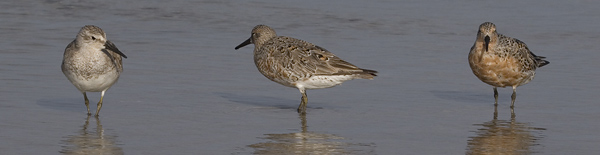
Standing out amidst a group of foot-dragging Atlantic coastal states, New Jersey has taken a courageous step to help save Red Knots and other shorebirds. Acting upon the strong urging of conservation organizations and concerned citizens, NJ legislators passed a bill to ban the harvest of horseshoe crabs in NJ. The legislation (A2260/S1331) was approved by the NJ Senate in a unanimous vote of 39-0, and signed into law by NJ Governor Corzine on March 25, 2008.
“The effects of human behavior often have widespread, unintended consequences that reverberate across the animal kingdom for generations, like the ripple effect in a pond that started out as one small disturbance,” Governor Corzine said. “It is with that in mind that we are here today to extend the moratorium on horseshoe crab harvesting, so as to reverse the endangerment and prevent the extinction of the red knot species and other shorebirds.”
“This moratorium will be held in place until the populations of both horseshoe crabs and red knots have returned to a level where they will be self sustaining as determined by the U.S. Fish and Wildlife service,” the Governor added.
The law comes none too soon, as the rufa and roselaari subspecies of the Red Knot continues to decline with alarming speed. The Delaware Bay area provides a critical feeding ground for Red Knots and other shorebirds, as they stop to feed on protein-rich Horseshoe Crab eggs, which sustain them during a long journey to their arctic breeding grounds. A report from 20 shorebird biologists around the world, issued in 2007, details the rapid and ongoing decline of the migratory Red Knot in the Western Hemisphere, linked to reduced availability of Horseshoe Crab eggs.
New Jersey’s action is an important step towards stabilizing the Red Knot population. But one state’s actions may not be enough to save the species from possible extinction. It is important for other Atlantic coastal states, especially Delaware, to take similar actions to limit Horseshoe Crab harvests and protect critical shorebird habitat.
Conservation organizations like National Audubon Society continue to fight to save the imperiled Red Knots and other shorebirds. They continue to petition the federal government to list the Red Knot as a Threatened Species, which they declined to do in 2006. Your voice counts too – contact elected officials and tell them to take all action to save shorebirds!
MERRITT
ISLAND UNDER NASA PRESSURE
By Jane Henderson,
March 19, 2008 (information provided by Wes Biggs and others)

© A Binns
Background Information
When NASA worked out the administration of the now MINWR and CNS areas of the Kennedy Space Center a half century or so ago, it was presumed that there would be little outcry if they decided to expand into these natural areas. But that was before 50 years of habitat destruction in surrounding areas, and the extinction of the Dusky Seaside Sparrow in Titusville, which drew worldwide attention.
In 2007 a study was conducted to assess 14 possible sites
on NASA property that would be suitable for the commercial vertical launch complex.
These proposed sites boiled down to two that were considered suitable for the
project. Site 1 is located along the Atlantic coast south of the Shuttle Launch
Complex 39A and north of the Atlas Complex 41. This is the area known as Kennedy
Space Center, and is closed to the public. Site 2 is located within MINWR east
of SR 3, north of SR 406 and south of the Scrub Ridge Trail.
Birders believe that either one of the proposed sites is unacceptable. Site
1 has a large population of Florida Scrub-Jays, Florida Gopher Tortoises, Florida
Beach Mice and Indigo Snakes. Site 2, which lies within the refuge, would involve
temporary as well as permanent closings of a number of areas within this ecologically
irreplaceable refuge which hosts a number of listed species. Areas that would
be affected, or possibly closed if Site 2 should be chosen, would be: Black
Point Wildlife Drive, The Merritt Island NWR Visitor Center, Cruickshank Trail,
Scrub Ridge Trail, Oak Hammock Trail, Palm Hammock Trail, Haulover Canal in
the vicinity of which are boat ramp, sports fishing, Manatee viewing and waterfowl
hunting.
There are other potential sites on NASA property for the proposed commercial vertical launch complex. Some of them are outdated, but could be revitalized and put to use. Birders believe that these and other sites should be considered for the development of the complex. For instance, NASA has not considered any sites on the adjacent Air Force Base because they have no jurisdiction over Air Force owned land. In our opinion, NASA and the Air Force should have discussed potential sites before starting this whole process. As has been suggested, a comprehensive study should be done to determine the most appropriate site for the launch facility on federally owned land at the Cape, regardless of which federal entity currently has jurisdiction.
A point-by-point outline of the situation from Wes Biggs in Titusville, FL
Both the Merritt Island National Wildlife Refuge and the Kennedy Space Center sites are unacceptable because:
The MINWR site should not be used because it would :
- Destroy endangered species habitat.
- Would waste the millions that have been spent over the years in habitat improvement, protection and research.
- Close areas off to the general public that would take millions of dollars out of the Titusville/Brevard County economies because:
- Over 200 fishing guides would be out of work
- Local businesses such as motels, restaurants, car rental agencies would have greatly reduced customer base.
The KSC site should not be used because:
- It would destroy even more important endangered species habitat
than the MINWR location.- There is more than enough space located on the Canaveral Air Force Station that already has most of the infrastructure that would be needed and it would destroy no important habitat.
NASA and the Air Force need to get together and figure out the best
place to put this thing.
A sample letter written by Jane Henderson
As a passionate birder, I want to add my voice to those protesting NASA’s proposed commercial vertical launch complex on 200 acres or more on what are now Merritt Island National Wildlife Refuge and Canaveral National Seashore.
I understand that Merritt Island National Wildlife Refuge and Canaveral National Seashore exist on property owned by NASA. Merritt Island NWR is an overlay of the Kennedy Space Center, and the Refuge manages NASA lands through an agreement which allows NASA to withdraw lands for space facilities. The proposed facility would result in a significant loss of scrub habitat, loss of wetlands, would impact sea turtle nesting due to lighting issues, would result in loss of habitat for several endangered or federally threatened species, and would eliminate the use of most visitor facilities and programs.
The development of either of these sites would affect approximately three quarters of a million visitors annually. This would amount to an average of over 2000 people a day. Impacts associated with the development of Site 1 or Site 2 to Playa Linda Beach on the CNS are unclear, but could potentially affect another three quarters of a million visitors a year. These visitors include hunters, birders, fishermen, boaters, hang gliders, hikers, beach goers and others.
I strongly believe that the only appropriate course of action for NASA to take is to preserve intact this area of phenomenal biodiversity in Central Florida and consider other more ecologically suitable sites for the launch complex.
A list of some of the area's Senators and Representatives
Pennsylvania Senators and Representatives
Bob Casey (Sen)
P.O Box 1177
Harrisburg, PA 17108Arlen Specter (Sen)
711 Hart Senate Office Building
Washington, DC 20510Patrick Murphy (Bucks Rep)
414 Mill Street
Bristol, PA 19007Allyson Schwartz (MontCo Rep)
706 West Avenue
Jenkintown, PA 19046Delaware Senators
Joseph Biden
201 Russell Senate Office Building
Washington, DC 20510Thomas Carper
513 Hart Senate Office Building
Washington, DC 20510New Jersey Senators
Frank Lautenberg
324 Hart Senate Office Building
Washington, DC 20510Robert Menendez
502 Hart Senate Office Building
Washington, DC 20510
Federal
Funding for Wetlands Habitat
(DVOC Conservation report, March 12, 2008)
© A Binns
Announcement from US Fish & Wildlife Service, Interior
Secretary Dick Kempthorne:
The Migratory Bird Conservation Commission, on March 12, 2008, approved more
than $29 million in federal funding for the protection and management of nearly
190,000 acres of wetlands and associated habitats in the U.S. that will benefit
ducks and waterfowl nationwide under the North American Wetlands Conservation
Act (NAWCA).
The Commission, composed of members of Congress and federal cabinet secretaries, and chaired by Secretary of the Interior Dirk Kempthorne, also approved nearly $3 million under NAWCA to enhance wetland and waterfowl management in Mexico and more than $4.2 million for the purchase of 2,213 acres of wetlands for inclusion in the National Wildlife Refuge System.
"The work of the Commission continues to provide vital support for wetlands and waterfowl conservation across North America,” said Secretary Kempthorne. "The President has charged the Department of the Interior to bring more of America's bird species into a healthy and sustainable status. The North American Wetlands Conservation Act and other work presided over by the Commission complements and strengthens other Interior efforts, such as the Birds Forever Initiative, better enabling us to secure habitat and ensure a promising future for our nation?s birds."
The more than $2.9 million approved for NAWCA's Mexico Grants Program will support 15 conservation projects in 11 Mexican states. Combined with almost $4 million in partner contributions, these projects will help to secure, enhance, and manage migratory bird habitat across Mexico, from Vera Cruz in the southeast to Baja California in the northwest.
The Commission’s approval of more than $29.6 million will support 31 projects in 21 states under NAWCA’s U.S. Standard Grants Program. Partners in these projects will contribute an additional $119.6 million in funds to help these conservation effects. The grants are funded by annual Congressional appropriations; fines, penalties and forfeitures levied under the Migratory Bird Treaty Act; interest accrued on funds under the Pittman-Robertson Wildlife Restoration Act; and excise taxes paid on small engine fuels through the Dingell-Johnson Sport Fish Restoration Fund.
The Commission’s approval of refuge acquisitions secured resting and feeding habitat that will be added to 4 National Wildlife Refuges located in 5 states. In addition, the Commission approved the acquisition of a permanent easement for the Grasslands Wildlife Management Area in California. The fund receives revenue from Duck Stamp sales, import duties on firearms and ammunition, and rights-of-way payments to the refuge system. Projects securing additional wetlands include:
- Cape May National Wildlife Refuge, Cape May County, New
Jersey - Acquisition of 280 acres will provide habitat for wintering and migrating
waterfowl species, particularly the American black duck.
- Grasslands Wildlife Management Area, Merced County, California - Acquisition
of 3 permanent conservation easements covering 1,035 acres will provide wintering
habitat for numerous waterfowl species, including the northern pintail, green-winged
teal, northern shoveler, and mallard.
- San Bernard National Wildlife Refuge, Brazoria County, Texas - Acquisition
of 142 acres will provide valuable habitat for wintering and migrating waterfowl
species, including the mallard, gadwall, northern pintail, mottled duck, and
American widgeon.
- Mackay Island National Wildlife Refuge, Currituck County, North Carolina and
Virginia Beach, Virginia - Acquisition of 26 acres will provide high quality
habitat for wintering waterfowl species, including the American black duck,
mallard, northern pintail, green winged teal, lesser and greater scaup, and
hooded merganser.
- Lacassine National Wildlife Refuge, Cameron Parish, Louisiana - A lease covering
640 acres will provide habitat for wintering waterfowl species, including the
mallard, northern pintail, American widgeon, gadwall, northern shoveler, Canada
goose, and white-fronted goose.
The Migratory Bird Conservation Commission meets three times a year and includes Senators Thad Cochran and Blanche Lincoln, Representative John Dingell, Secretary of Agriculture Mike Johanns, and Environmental Protection Agency Administrator Stephen L. Johnson, with Interior Secretary Dirk Kempthorne serving as Chairman.
Additional information about the Act can be found on
the U.S. Fish and Wildlife Service Website at http://www.fws.gov/birdhabitat/Grants/NAWCA/index.shtm.
LEGISLATION
BANNING NJ HORSESHOE CRAB HARVEST MOVES FORWARD
Update from Eric Stiles, VP Conservation, NJ Audubon
Society – March 3, 2008
Please excuse the frequency of these emails and updates, but we are just about to cross the finish line in saving the Red Knot from extinction!
Great news! Just yesterday (March 2, 2008), the NJ Assembly Agriculture and Natural Resources Committee, by a vote of 5-0, forwarded the Horseshoe Crab harvest moratorium for vote by the full Assembly. The Committee members include Assemblymen Doug Fisher, Nelson Albano, John Amadeo, Marcia Karrow, and L. Harvey Smith. Special thanks to Assemblymen John McKeon and Doug Fisher are merited!
We urgently need your help moving this legislation through the Senate Environment Committee. Please take the time to call Senate committee members and ask them for them to move the legislation out of committee on March 10, 2008. Please send an email to [email protected] to report any conversations that you had including commitments and results.
Contact these NJ Senate committee members:
Senator Jeff Van Drew (609)-465-0700 or [email protected]
Senator John Adler (856)-489-3442 [email protected]
Senator Christopher Bateman (908)-526-3600 [email protected]
Senator Bob Gordon (201)-703-9779 [email protected] (thank him for being leader
on this!!)
Senator Bob Smith (732)-752-0770 [email protected]
Senator Andrew Ciesla (732)-840-9028 [email protected]
Talking Points:
1) Legislators must move the the horseshoe crab moratorium legislation (S1331) out of the Senate Environment Committee on March 10, 2008. They should also commit to co-sponsoring the legislation and voting for the bill when it comes before the full Senate.
2) The moratorium needs to last until the Delaware Bay shorebird populations and spawning horseshoe crabs have fully recovered.
3) Due to the overharvest of horseshoe crabs, the Red Knot, a robin-sized shorebird, is facing extinction and two other shorebirds, Semipalmated Sandpipers and Ruddy Turnstones, are facing significant declines.
4) This legislation is needed since the NJ Marine Fisheries Council vetoed NJDEP horseshoe crab moratorium regulations. The NJ Marine Fisheries Council decision runs counter to the science and sets the Red Knot on a course towards extinction.
5) The Delaware Bay, our Serengeti, is one of the top four most important shorebird stopover sites in the world. We must be responsible stewards for this gem! Wildlife watchers visiting the Delaware Bay to view shorebirds and horseshoe crabs contribute up to $42 million per year to the local NJ economy.
Thanks for your help to save the shorebirds on the Delaware Bay!
P.S. The letter-writing strategy outlined below is also effective – the letter sample remains valid and current. Write, call or email now!
HOPE
FOR RED KNOTS – PROPOSED LEGISLATION TO BAN HORSESHOE CRAB HARVEST
Update from Eric Stiles, VP Conservation, NJ Audubon Society – February
27, 2008
© A Binns
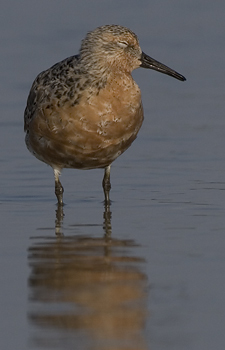
We have great news to share. After the NJ Marine Fisheries vetoed the NJDEP horseshoe crab harvest moratorium regulations [on February 11, 2008], legislators have taken strong action by introducing legislation (A2260/S1331) to ban the harvest of horseshoe crabs in NJ. This action will help ensure the continued survival of Red Knots and other shorebirds from extinction.Red Knots need your help once again.
1) Take action through www.njaudubon.org and let your legislators know that you urge them to co-sponsor this legislation and ensure its passage by March 17, 2008.
2) The Horseshoe Crab moratorium legislation (A2260) will be on the Assembly Agriculture and Natural Resources Committee agenda this Thursday, February 29, 2008 at 2 pm. Strong support is needed. It would be great if you could come out to Trenton and join us in Committee Room 9, 3rd Floor, State House Annex, Trenton, New Jersey. Please send an RSVP to [email protected] if you can attend.
3) Send a letter to decision maker(s) - Your Assemblyperson
and Your State Senator
[Note: Mail a typed, signed letter, but address the envelope in hand-writing
– it gets more attention!]
Below is a SAMPLE LETTER:
| Subject:
Halt the Harvest, Save the Red Knot
Dear [name of Assemblyperson or State Senator], I am writing to ask for your help to save the Red Knot from extinction by supporting legislation to ban the harvest of horseshoe crabs in New Jersey. Specifically, I urge you to co-sponsor A2260/S1331 and ensure its passage into law before the legislature goes on recess on March 17, 2008. The moratorium needs to last until the Delaware Bay shorebird populations and spawning horseshoe crabs have fully recovered. The legislation is needed for the following reasons: 1) Due to the overharvest of horseshoe crabs, the Red Knot, a robin-sized shorebird, is facing extinction and two other shorebirds, Semipalmated Sandpipers and Ruddy Turnstones, are facing significant declines. 2) Shorebirds rely on a superabundance of adult spawning horseshoe crabs to produce sufficient crab eggs for foraging shorebirds. 3) This legislation is needed since the NJ Marine Fisheries Council vetoed NJDEP horseshoe crab moratorium regulations. The NJ Marine Fisheries Council decision runs counter to the science and sets the Red Knot on a course towards extinction 4) The NJ Marine Fisheries Council vote shows that the council majority consists of commercial industry representatives and not the public interest. New Jerseyans and future generations deserve and demand conservation of our natural heritage! We also appreciate the support of recreation angler representatives on the Council. 5) The Delaware Bay, our Serengeti, is one of the top four most important shorebird stopover sites in the world. We must be responsible stewards for this gem! 6) Wildlife watchers visiting the Delaware Bay to view shorebirds and horseshoe crabs contribute up to $34 million per year to the local NJ economy. Extinction is forever, so I hope that I can count on your support to save our natural heritage for our children's future. I look forward to your response. Sincerely, |
DVOC
CONSERVATION AWARD TO LARRY NILES
(by Debbie Beer, DVOC Conservation Chairperson,
February 22, 2008)
On February 21, 2008, the DVOC Conservation Committee was pleased to present our 2007 Conservation Award to LARRY NILES, for his tireless efforts and outstanding achievements in the area of conservation, most recently as retired Chief Biologist of New Jersey Division of Fish & Wildlife Endangered Species program, and also as consultant to the non-profit organization, Conserve Wildlife Foundation of NJ.
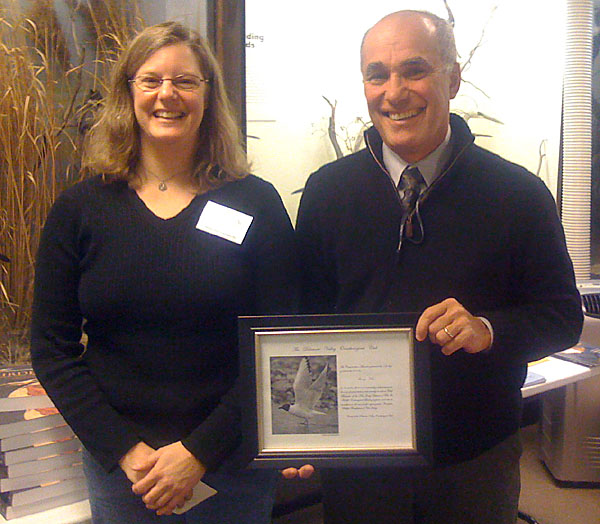
Conservation Chairperson Debbie Beer presents the
2007 Conservation Award to Larry Niles
In particular, Larry works diligently to protect Red
Knots along the Delaware Bay, conducting research in their arctic breeding grounds
and Tierra del Fuego. Our Conservation Award was particularly timely, as Larry
provided us with an update in the Red Knot status, which is in the news since
the NJ Marine Fisheries Council recently voted not to continue the two-year
moratorium on Horseshoe Crab harvesting. Larry and his wife Mandy urged everyone
to contact NJ Governor Corzine via phone or hand-addressed envelope, and ask
him to legislate the moratorium on Horseshoe Crab harvesting. (See Red Knot
report below).
HORSESHOE
CRAB MORATORIUM EXPIRES IN NJ – RED KNOTS REMAIN IMPERILED
(by Debbie Beer and Tony
Croasdale, February 12, 2008)
© A Binns
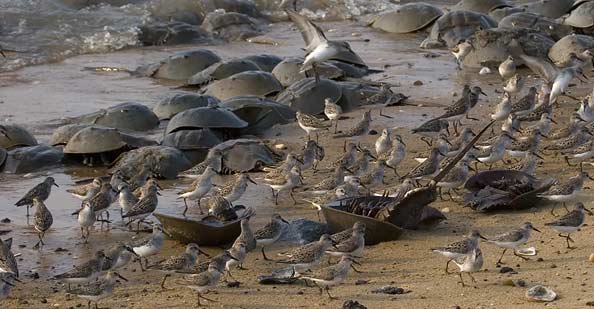
As Red Knots prepare for another migration northward this Spring, unfortunately, they’ll get no reprieve from their continued struggle for subspecies survival. In a special meeting held on February 11, 2008, the NJ Marine Fisheries Council ignored the pleas of NJ Department of Environmental Protection, conservation organizations and citizens, and voted not to extend the Horseshoe Crab harvest moratorium. Each spring, Red Knots and other shorebird species stop along the Delaware Bay to feed on protein-rich Horseshoe Crab eggs, a critical food source to sustain them during a long journey to their arctic breeding grounds. The shortage of Horseshoe Crabs (and their eggs) correlates with a dangerous decline in the rufa subspecies of the Red Knot population. Strong conservation measures need to be implemented – and maintained – immediately, to prevent the species from extinction, which may occur in as little as five or ten years.
Below is a powerful message from DVOC member Tony Croasdale, who attended this important meeting. His energy and passion serve as inspiration and motivation for conservation actions.
“I just returned from the meeting of the New Jersey Marine Fisheries Council and my heart is heavy with the sad news that the council, despite the recommendations of New Jersey Department of Environmental Protection and overwhelming public sentiment, voted 5 to 4 to veto the horseshoe crab harvest moratorium. There will be a limited harvest of 150,000 male crabs.
As discouraged as I am about his news I feel empowered for the insight into politics that this has given me and feel I have clarity about the next course of action and knowledge of how to proceed on related issues in the future. First of all I learned of the importance of writing personal letters of comment and letters to legislators. A break down of comments on the horseshoe crab harvest moratorium was read at the meeting and figures were given for both personal letters and signatures to petitions. About 1,700 comments for supporting the moratorium were submitted as opposed to only 14 against the moratorium. Of those 1,700 positive comments only about 50 were personal letters and the rest mass petitions. Of the comments only 4 were for a total stop to the moratorium, the other 10 supported a male only harvest.
The other lesson I learned was to always sign up to speak at these hearings, you can always decline later. I didn't understand the comment procedure and did not sign up in advance. Had I arranged to speak I would have made a comment not addressed in the meeting, refuted a false statement by the pro crab harvest lobby and added a personal anecdote not expressed by any other speaker. No one addressed how the male only limited harvest would be enforced. A comment was made that the US Fish and Wildlife Service did not choose to list the Red Knot and therefore did not consider it to be endangered. That is not true, the USFWS recommended that the Red Knot be a candidate for listing, however to formally list a species the USFWS must also have funding available for protective measures and that funding was not available. (Thank you George Bush)
The personal anecdote I would have made were my own memories of seeing the crab and shorebird spectacle when I was nine years only through my early teens, only to return to birding in my mid twenties and see that amazing phenomena decimated.
The other thing is that only a few people who spoke were not representatives of conservation groups. You can be proud of the powerful and eloquent statements made by Eric Stiles of NJ Audubon and by Sheila and Marlene of CMBO. But private citizens need to show up in numbers to these hearings and raise their personal voices.
The next course of action is to demand that the NJ state legislature override the power of the NJ Marine Fisheries Council and enact a moratorium. The state has this authority and in fact several members of the NJMFC expressed concern that vetoing the moratorium would give the state reason to take more power away from the NJMFC.
It seems to me that someone who has the predilection to serve as a member of the NJ Marine Fisheries Council could very well have a bias towards the commercial fishing industry. And in fact one member even stated that their job was to "represent the interest of the commercial fishermen". The two public seats of the council stand empty. I believe that an issue this important that impacts the continued persistence of an entire subspecies of non game and non commercial value and is not a marine animal to not be in the hands of only nine people who regulate commercial and sport fisheries. This decision needs to be in the hands of the Department of Environmental Protection and the state legislature.
The future of the rufa subspecies of red knot could have come down to one person's decision.
As birders it is now our time to flex our muscle. We must pressure our legislators to reinstate the moratorium and take the power of this decision away from the New Jersey Marine Fisheries Council.
We must in the meantime demand strict regulation of the male only limited harvest. I am suggesting people volunteer to be observers and even offer to serves as auxiliary members of whatever regulatory agency has jurisdiction over the harvest. I know this may lead to some confrontations, but a subspecies' continued existence is at stake here.
I've been told that the state offered to compensate the watermen for their eel and conch harvest losses incurred for a continued moratorium agreement. The watermen refused the offer because they had to present tax documents. If the watermen cannot be trusted to correctly report their earnings then how can they be trusted to only take male crabs and to honor the bag limits especially when there is no way to effectively enforce the limits?
The heath hen is gone, the dusky seaside sparrow is gone, let us not let another unique subspecies go extinct. Let us act while sanderlings, semipalmated sandpipers, and ruddy turnstones also continue to decline.
Let this be the issue that finally galvanizes birder's political resolve. In solidarity save the red knot!”
( 2/14/08) Eric Stiles from NJ Audubon
that suggests people.....
2/14/08) Eric Stiles from NJ Audubon
that suggests people.....
Write letters to the editor in papers (please copy Eric Stiles on submissions) which ran stories about the issue with the following points:
1) You strongly disagree with and are extremely disappointed in the NJ Marine Fisheries Council and its decision.
2) The NJ Marine Fisheries Council decision runs counter to the science and sets the Red Knot on a course towards extinction.
3) The NJ Marine Fisheries Council vote shows that the council represents special interests and not the public interest. New Jerseyans and future generations deserve and demand conservation of our natural heritage!
4) Thank NJ Department of Environmental Protection for its outstanding science and policy work.
5) Call Governor Corzine at 609-777-2500, and ask him to take immediate action to ensure a horseshoe crab harvest moratorium is enacted prior to April. Call local legislators too.
6) The moratorium needs to last until the Delaware Bay shorebird populations and spawning horseshoe crabs have fully recovered.
7) The Delaware Bay, our Serengeti, is one of the top four most important shorebird stopover sites in the world. We must be responsible stewards for this gem!
Letters should also be sent to New Jersey legislators
directly. Jersey residents should write to their senator and assemblymen and
everyone should write to Gov Gorzine.
To find your NJ senator or assemblymen: http://www.njleg.state.nj.us/members/legsearch.asp
Gov Corzine: http://www.nj.gov/governor/govmail.html
Office of the Governor
PO Box 001
Trenton, NJ 08625
609-292-6000
Brown
Pelicans Rebound
(by Debbie Beer, DVOC Conservation Chairperson,
February 10, 2008)
© A Binns
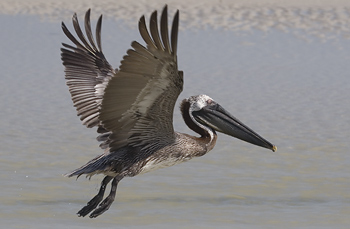
Brown Pelicans joined the ranks of Endangered Species Act success stories, since Secretary of the Interior Dirk Kempthorne announced on February 8, 2008, the intention to remove the remaining protected populations from the Endangered Species List, a process that could take up to a year.
“Thanks to decades of coordinated efforts on the part of state and federal agencies, conservation organizations and private landowners, the pelican has rebounded to historic levels,” said Kempthorne, during an appearance in Baton Rouge. Louisiana, known as the “pelican state,” has been a key partner with the U.S. Fish and Wildlife Service (FWS) in efforts to recover the pelican in the Gulf Coast region.
The pelican’s (and other birds) recovery is due in large measure to the federal ban on the general use of the pesticide DDT in 1972, after former U.S. FWS biologist Rachel Carson published Silent Spring, warning the nation about the dangers of unrestricted pesticide use. But pelicans suffered long before the DDT-era, with populations plummeting due to plume collecting in the late 1800’s and killing over perceived competition for fish.
This dynamic, plunge-diving bird is a big reason behind the National Wildlife Refuge System. Over 100 years ago in central Florida, German immigrant Paul Kroegel became appalled by the indiscriminate slaughter of pelicans for their feathers. His impassioned pleas to President Theodore Roosevelt led to the creation of the first National Wildlife Refuge at Pelican Island in 1903.
In 1970, the U.S. Fish and Wildlife Service listed the Brown Pelican as an endangered species (under a law that preceded the Endangered Species Act of 1973). In 1985, populations on the Atlantic Coast of the U.S. (including all of Florida and Alabama), had recovered to the point that the species was removed from the Endangered Species List in that part of its range. Up to the current proposal, the Endangered Species Act continued to protect populations in the U.S. Gulf and Pacific Coasts, and in the Caribbean, Central America and South America. The U.S. FWS estimates there are now over 620,000 Brown Pelicans found across these ranges.
If the Brown Pelican is removed from the list of threatened and endangered species, other federal laws, such as the Migratory Bird Treaty Act and the Lacey Act, would continue to protect the Brown Pelican, its nests and its eggs from harm. U.S. FWS would work with state agencies, organizations and citizens to ensure that the species remain monitored and protected.
Ongoing threats to Brown Pelicans (and other species), include oil and chemical spills, entanglement in fishing gear, and alarming rates of habitat loss. The Migratory Bird Treaty Act does not offer any habitat protections to avian species, even while they protect the well-being of nests and individual birds.
The proposal to remove the bird from the list of threatened
and endangered species will be published in the Federal Register. The Service
will seek comments on the proposal for 60 days following publication. Comments
may be submitted by hand-delivery or mail to the Public Comments Processing,
Attn: RIN 1018-AV28, Division of Policy and Directives Management, U.S. Fish
and Wildlife Service, 4401 N. Fairfax Drive, Suite 222, Arlington, VA 22203.Comments
may also be submitted electronically on the Federal eRulemaking portal at http://www.regulations.gov.
IMPORTANT
BIRD AREAS
(by Debbie Beer, DVOC Conservation Chairperson,
February 4, 2008)
© A Binns
(Excerpted from the National Audubon Society website):
National Audubon Society’s Important Bird Areas Program (IBA) plays a
critical, global role in identifying and conserving vital areas for birds and
other biodiversity. With the IBA program, Audubon links local chapters with
landowners, public agencies, community groups, and other non-profits, in a broad
network of action and support, to ensure that Important Bird Areas are properly
managed and conserved.
Important Bird Areas, or IBAs, are sites that provide essential habitat for one or more species of bird. IBAs include sites for breeding, wintering, and/or migrating birds. Areas may be a few acres or thousands of acres, public or private lands, protected or unprotected.
To qualify as an IBA, sites must be uniquely important to birds, by providing habitat to a species of conservation concern (threatened or endangered), hosting high concentrations of a species, or meeting one of the other criteria put forth by the National Audubon Society. A site may be important at the global, continental, or state level.
The IBA Program was initiated by BirdLife International, a global coalition of organizations, in Europe in the 1980's. Since then, over 8,000 sites in 178 countries have been identified as Important Bird Areas. As a partner of BirdLife International, the National Audubon Society launched its IBA initiative in 1995, and administers the program in the U.S. More than 2,100 state-level IBA’s, encompassing over 220 million acres, have been identified in 48 states, with conservation activities conducted at most.
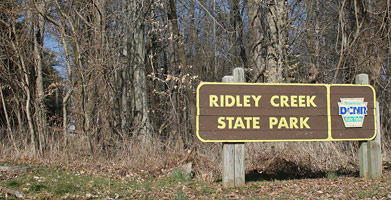
In Pennsylvania, 85 IBA’s have been identified, with conservation action plans implemented for many of them. Local IBA’s include: Hawk Mountain Sanctuary and the Kittatiny Mountain Ridge, Ridley Creek State Park & Tyler Arboretum, John Heinz NWR at Tinicum, Fairmount Park complex and Benjamin Rush State Park, Peace Valley Park, Green Lane Reservoir,
The densely-populated state of New Jersey hosts 122 IBA’s, grouped into 5 distinct habitat regions: Atlantic Coastal, Delaware Bay, Piedmont/Plains, Pinelands, and Skylands. Well-known IBA’s include: Forsythe NWR, Island Beach State Park, Barnegat Lighthouse State park and inlet, Cape May NWR, Sandy Hook Gateway NRA, Stokes State Forest and more. Atlantic City Airport and Arthur Kill complex also count among the numerous IBA’s in NJ.
The small state of Delaware hosts 4 IBA’s, as listed on the Audubon website: Delaware Coastal Zone, Great Cyprus Swamp Conservation Area, Pea Patch Island, White Clay Creek State Park and Preserve.
The IBA Program helps birds by setting science-based priorities for habitat conservation and promoting positive action to safeguard vital bird habitats. IBA inventories provide a scientifically-defensible method for prioritizing conservation activities and allocating limited conservation dollars to ensure the maximum benefit to birds.
Opportunities abound for volunteer, citizen science participation in the IBA program on many levels, including monitoring, data-collecting, outreach and education. Such participation promotes local stewardship and advocacy. The IBA program provides a foundation for on-site conservation efforts.
By working to identify and implement conservation strategies
at Important Bird Areas, Audubon hopes to minimize the devastating effects of
habitat loss and degradation on birds and other wildlife. Frank Gill, Senior
Ornithologist, National Audubon Society, believes “IBAs have the unique
power to unite people, communities, and organizations in proactive bird conservation,
one place at a time.” Get involved now! Visit the Audubon website at http://www.audubon.org/bird/iba/