Click here for information on this image

DVOC Main Page > Birding the Delaware Valley Region > Pelagic Birding
Contact Information

To suggest additional links or to report broken links email

Pelagic Birding

On this page:

Click Here for Pelagic Weather Resources

......................................................................................................................................

What Birds Might Be Seen?
 

Beginning - Mid March
These trips have been run for well over a decade, and have produced good winter seabirds in the past. The primary focus will be alcids and past sightings include Razorbill almost every year, Dovekie several times (high of 733), Atlantic Puffin several times, Common Murre on almost half of the trips, and Thick-billed Murre once.

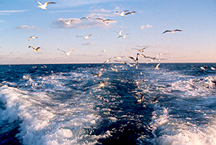
Great Skua and Northern Fulmar have also been seen. Gannets and Kittiwakes are regular. We'll chum as we go to keep gulls, gannets, and hopefully a skua at the back of the boat. We also stop for any whales. This trip has produced Fin Whale several times and an incredible show by two Northern Right Whales in 1998. FYI for state listers, we will be in both NJ and DE waters.


End of May
Possible birds include Sooty, Cory’s and Manx Shearwaters; 3 Jaegers, South Polar and Great Skua; Arctic Tern, (Bridled Tern was seen off Cape May in 2000); Northern Fulmar, Red and Red-necked Phalarope; Wilson’s and Leach’s Storm Petrel. Atlantic Puffin has been seen off Cape May at this time of the year). Sharks, Whales and Dolphins possible.

Beginning of June
Possible birds include Cory's, Greater and Sooty Shearwaters; Wilson's and Leach's Storm-Petrels; Parasitic, Pomarine, and Long-tailed Jaegers; South Polar Skua, Arctic Tern, Northern Gannet, Red and Red-necked Phalaropes.   Bridle Terns in 2000. Also 2 South Polar Skuas and 2 Long-tailed Jaegers.

End August - Beginning Sept
At a prime time for Long-tailed Jaegers (mostly juveniles) during their southward migration. All 3 species of Jaegers and South Polar Skua are possible. Also at a prime time for Shearwaters (Greater, Cory’s and Audubon regular, Manx and Sooty much rarer) and Storm-Petrels. Among the latter, numerous Wilson’s, with others possible: Leach’s in migration, White-faced and Band-rumped possible, as well.


Beginning of December
Great Skua, various alcids, Northern Fulmar, white-winged gulls, Manx Shearwater, Red Phalarope, Pomarine Jaegar, Gannets, and Kittiwakes. During this winter trip, the last 8 years: Dovekies in areas of plankton (6 years), Atlantic Puffin (5 years), Razorbill (6 years), Common Murre (2 years), Iceland & Glaucous Gulls (6 years), and Great Skua (3 years)

Tour Operators
 

See Life Pelagics :
Paul Guris has scheduled a series of pelagic trips for 2005. Belmar trips cover NJ and NY waters, Lewes trips cover DE and MD waters and Cape May trips cover NJ and DE waters. Check out his website for specific details.

Communications aboard the boats:
We are planning on using FRS radios to communicate between the leaders. We will be on channel 11, and no sub code will be used. All participants are encouraged to bring their own radio so they can listen in and, if they see a potentially good bird, report it. Due to the potential number of radios, idle chitchat is strictly verboten, and we'll ask people not to bother reporting regular species like gannets, loons, etc.

We are hoping that this will help fix the two major communication problems aboard pelagic trips. The first is getting sightings around to all of the people. While PA systems help, sometimes they are garbled, drowned out by engine noise, and there is always a delay relaying info to the person with the microphone. This last one makes it hard to get people on fly-by birds. The other problem is not hearing about participant’s sightings. Several times we have heard about possible good birds after the fact because people didn't speak up. Remember that on any trip the participants greatly outnumber the leaders, so why not take advantage of all that birding power!

What to bring:
Be sure to dress appropriately. It can be much colder at sea than you might think but, especially in the summer, mild weather is possible. Binoculars, of course, are essential. Scopes, except on gunstocks, are generally not allowed. Cameras are good. Be sure to bring food, lots to drink and plenty of snacks. Sunscreen, sunglasses and a hat (with strap), any seasick medications you need (read the label, most recommend taking medication more than 12 hours before the trip, NOT at the DOCK!); field guides (we'll have these, but if you want a certain one, bring it!) Please share coolers or bring a small cooler; space is limited on the Skipjack and space is limited inside on the Morning Star. It's OK to bring a larger cooler and "cooler-pool" at the dock. Please, no bananas or ponchos!

BTW, I would love to get feedback from people about this idea, either on list or off. When I report the trip results, I will give an assessment of how it all worked out.

2005 Dates

  • Sunday, March 6, 2005 - Cape May, NJ
  • Saturday, April 16, 2005 - Lewes, DE
  • Saturday, April 23, 2005 - Belmar, NJ
  • Saturday, June 4, 2005 - Lewes, DE
  • Saturday, August 20, 2005 - Belmar, NJ
  • Saturday, August 27, 2005 - Lewes, DE
  • Saturday, October 22, 2005 - Lewes, DE
  • Saturday, December 3, 2005 - Belmar, NJ
  • Saturday, December 10, 2005 - Lewes, DE
  • Friday, December 30, 2005 - Belmar, NJ
    Hudson Shelf Valley Christmas Bird Count

Boats

"Atlantis"
Capt. Francis Brogan (732) 528-5014
(100’ vessel, with large cabin, lots of upper and lower deck space, microwave, hot water and food aboard)

"Miss Barnegat Light"
Capt. Larson (609) 494-2094
(95’ catamaran, capable of 25 knots, stable, large cabin, upper and lower decks, speaker and galley. Food available for purchase)

"Miss Chris"
Capt. Fred Ascoli (609) 884-3939
(65' fishing boat with full walk-around.)

"Morning Star"
Capt. Bill Bittman (609) 861-7085

"Skipjack"-
Capt. Pete Floyd (302) 645-5297
(A small boat that catches a lot of spray. Participants must bring raincoats and rain pants on the trip as well as waterproof boots. The boat has a covered cabin but it is open at the back or shielded with plastic.)

"Deep Adventure"
A fast 80-foot boat (the return to shore from the canyon for this trip would be 4 hours). Food & drink is available on board. The "Deep Adventure" has 20 bunks.

"Nighthawk"
A 100-foot boat with good speed (the return to shore from the canyon for this trip would be 5 hours). Food & drink is available onboard.

Paul A. Guris
1604 Woodland Road
Green Lane, PA 18054
Phone: (215) 234-6805
See Life Pelagics

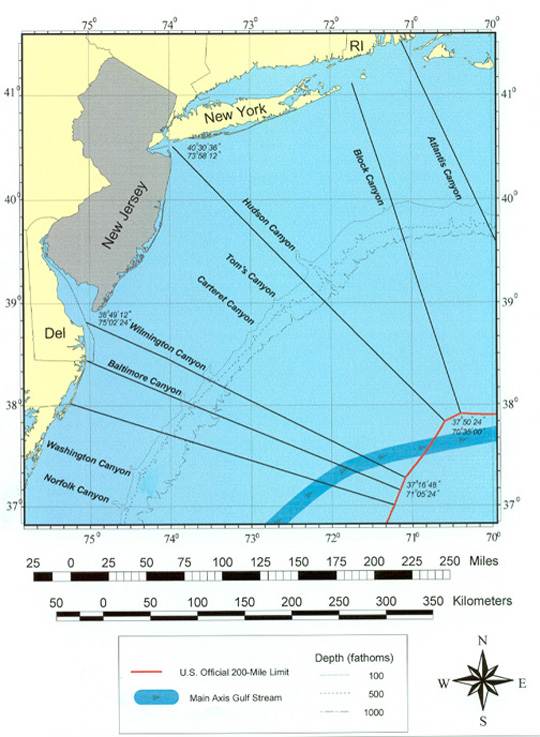
Pelagic Listing Boundary Lines

Pelagic Boundaries Map
supplied by P.A. Buckley and M. Nicholson

Explanation of Pelagic Boundaries
~ P.A. Buckley

The lines on the map have been drawn after an exhaustive comparison of approaches to defining pelagic boundaries that considered 2 additional, sometimes-used approaches. These are 'going due east' and 'nearest-land' or in this case, 'nearest state.'

I applied accepted international law and cartographic techniques in all cases, and they both immediately ruled out the 'go due east until you reach 200nm' approach advocated by DEL. It is untenable except where the coastline is exactly due N-S. That left the 'nearest-state' technique, which was also rather quickly ruled out because, inter alia, it did not allow several states -- Rhode Island, Delaware, and Virginia, in fact! -- to even REACH the 200nm boundary, and also because it violated egregiously one of the first principles of international maritime law, that states' areas at sea should be roughly proportional in some consistent way to their shoreline lengths.

Then, given that there exists already an official US-drawn line that delimits the US’s Exclusive Economic Zone (EEZ) boundary 200 nm at sea, I took a good look at that line. Even though smoothed, it clearly follows the general US coastline (that is, it 'buffers' it), and in addition has several 'inflection points' that conform to major coastal topographic discontinuities such as the mouths of Chesapeake and Delaware bays, the entrance to NY Harbor (aka/ the apex of the NY Bight), and so on.

Then, following established interstate boundaries from the actual shorelines off to 12 miles, I extended the lines until they intercepted those EEZ inflection points. In a few places where there were none, the intersection point was determined as proportional to the shoreline lengths of the involved states.

In other words, it was all very objective, legal, and consistent.

NEW JERSEY’S Official Position on Boundary Lines
At this time the NJBRC has not issued a position on official pelagic boundaries nor does it have any official pelagic boundaries.

Joe Burgiel (NJBRC) writes, "At the moment, NJ pelagic boundaries are not well defined and we are simply recording the locations of all pelagic records. Historically, our boundaries were more or less shaped by where pelagic trips from NJ usually went. This included all of Hudson Canyon but none of Wilmington Canyon. Since this definition is vague, we will in the future adopt a more precise one, whether it be the Buckley definition, nearest point of land, or other."

DELAWARE’S Official Position on Boundary Line
The Delaware Bird Records Committee defines the Delaware waters as the latitude of the Delaware/Maryland border - 38 degrees 27' 4"N to the latitude of the tip of the outer breakwater at Cape Henlopen - 38 degrees 50'N. The water extends east 200 nautical miles

Sea Conditions


Code

Description

Height (m)


0

Calm (glassy)

0


1

Calm (rippled)

0 to 0.1


3

Smooth (wavelets)

0.1 to 0.5


4

Slight

0.5 to 1.25


5

Moderate

2.5 to 4


6

Rough

4 to 6


7

High

6 to -9

 
8
Very High 9 to 14
 

9

Phenomenal

>14


Note:

1 meter = 39.37 inches


1 meter = 3' 3.37"


  Beaufort Wind Scale


0

Calm, sea like a mirror

<1


1

Light air, ripples only

1 to 3


2

Light breeze, waves 0.2m, glassy crests

4 to 6


3

Gentle breeze, waves 0.6m, breaking crests

7 to 10


4

Moderate breeze, waves 1m, some white horses

11 to 16


5

Fresh breeze, waves 1.8m, many white horses

17 to 21


6

Strong breeze, waves 3m, some spray

22 to -27


7

Near gale, waves 4m, foam

28 to 33


8

Gale, waves 5.5m, crests break into spindrift

34 to 40


9

strong gale, waves 7m, dense foam

41 to 47


10

Storm, waves 9m, visibility impaired

48 to 55


11

Violent storm, waves 11m, visibility poor

56 to 63


12

Hurricane, waves 14m, visibility bad

>64


Note:

1 knot = 1.15 mph or 1.85 kmph


Additional Information

Whale Watching Boats:

Avalon Sea Watch - Avalon, Cape May County, New Jersey

Information on this page supplied by Adrian Binns and Paul Guris