DVOC Main Page
> Ornithological Studies > Scaup
Ornithological Presentation
Greater Scaup and Lesser Scaup
Study skins from the collection of the Academy of Natural Sciences
by Adrian Binns 1/05
Click here for a webpage prepared by VIREO for DVOC on this topic.
| Aythya marila |
Aythya affinis |
|
|
Name |
Aythya: Greek for “a kind of waterbird or diving bird”. Marila: from the Greek marile for “charcoal”. Scaup is Scottish for a ledge that may be partially
exposed at times above the surface of the water. Scaup also comes
from Scaup bank which provides a bed for shellfish, which of
course the birds feed on. |
Affinis: Latin for “related”, as in related to Great Scaup. |
|
Head Shape |
Best seen on sleeping birds.
More rounded nape contour. Peak of the head is further
forward. |
Smaller head with taller crown
peaked towards the rear of the crown. |
|
Head Color |
Usually greenish. The color
of the head gloss in males varies depending upon light conditions and both
species can show bright green or purple gloss. |
Usually purplish. |
|
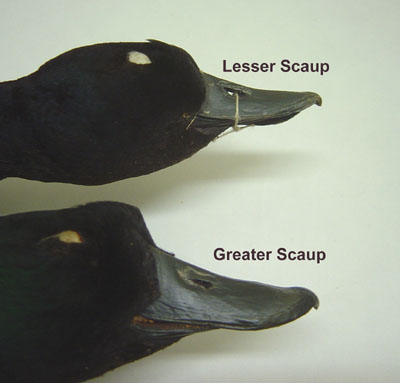
Bill
Shape |
Deeper at the base and proportionately
larger and broader than Lesser’s. Viewed from the side, the upper
outline of the bill makes a slightly straighter line. Click Here to see images |
Viewed from the side, the upper
outline of the bill makes a slightly more concave line, especially towards
the base. |
|
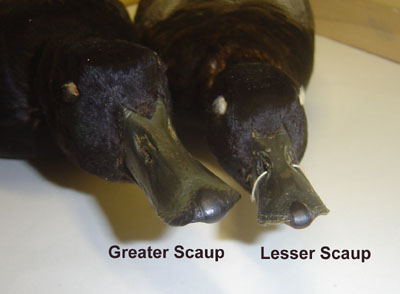
Nail on Bill |
Noticeably and proportionately
larger. The black usually spreads out beyond the nail onto the
rest of the bill tip. Harder to see on females due to the darker bill and
more variable. Click Here to see images |
Smaller black nail that is sharply
outlined against the pale blue. Click Here to see images |
|
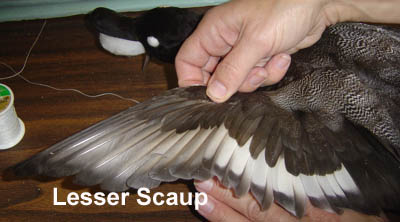
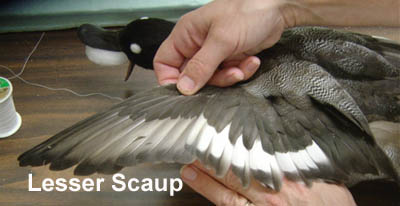
White-wing
Stripe |
The white wing stripe typically extends out from the secondaries onto the inner 6 primaries, reaching more than half way from the bend in the wing to the wingtip. | The white wing stripe typically
extends only across the secondaries, cutting off sharply
at the primaries, which are gray. Some Lesser males can show ‘extra’
white, while some Greater females can show ‘less extensive’
white. |
|
White
at Base of Bill |
On average female Greaters have
more white around the base of the bill, but the difference is slight and
probably of not much use. |
|
|
Flank
Pattern |
On males, usually a very clean white | On males, usually Lessers have
extensive fine gray vermiculations – hard to see
in the field, though is does occasionally give the flanks a ‘clouded’
appearance. |
|
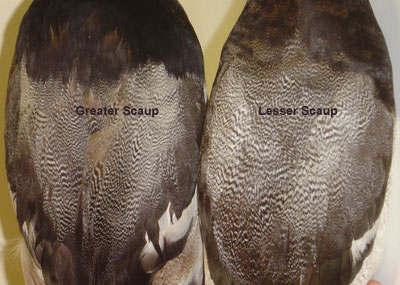
Back
Pattern |
The back and scapulars of adult
males in both species are finely barred with black and white zigzags, which
blend to a pale gray when seen at a distance. These White markings are finer
(not as wide as the black ones) in Greater. Click Here to see images |
The back and scapulars average
heavier and coarser barring on adult males – the White barring is
wider than the black. |
DVOC Main Page > Ornithological Studies > Scaup