DVOC Main Page > Ornithological
Studies > What's This > Picture 11
What's This?
Picture 11
Submitted by Adrian Binns
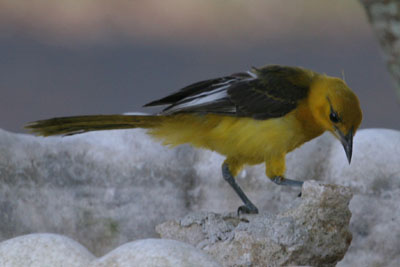
This is obviously an oriole, but the plumage is certainly not something that one is use to seeing.
Some features that we can see on this bird are that.....
1. the overall coloration is of an even orangish on the head and slightly lighter
on the underparts with darkish wings.
2. the wings show a white tertail wedge
3. there is no noticeable wing bars, other than a faint yellowish tip to the
median coverts
4. the bird is very long - especially noticeable is the length of the tail
5. it shows a long slightly decurved bill
6. the base of the bill on the lower mandible shows a pinkish coloration
7. there is a fine dark post-ocular stripe
1. We can eliminate the "yellow" orioles (Scott's
and Audubon's) because neither ever shows orange in any plumage. That leaves
Orchard, Baltimore, Bullock's, Hooded, Altamira and Spot-breasted as the only
other likely North American possibilities.
The fact that it does not show any black around the face and bib eliminates
it from being an adult male or even an immature male. While female Scott's,
Orchard, Baltimore and Bullock's do not show black in the face they do show
well defined white wing bars. Bullock's and Hooded females tend to show a very
pale belly that contrasts with the breast and undertail. Orchard has an overall
light coloration that this bird does not show, while Baltimore has an orange
color. Female Spot-breasted and Altamira's are indistinquishable from the males.
This leaves us with a likely juvenile.
2 and 3. This feature, the white tertail wedge, along with the lack of white
wingbars seperates it from all other orioles. As adults, most orioles show a
white tertial wedge to some extent, it is only the Spot-breasted that shows
this in all plumages. An Altamira juvenile (orangish) show no white in the wings
at all. Juvenile Bullock's are overall yellowish and grey; Hooded are greenish,
whereas Orchard's are yellowish with washed buff upperparts. Baltimore juvs
can show considerable orangish coloration but have obvious white wing bars.
4. This features pretty much eliminates Orchard, Hooded, Bullock's and Baltimore
though it is subjective. Altimara' and Spot-breasted tend to show longer tails
but that may just be because they are larger birds.
5. Baltimore, Bullock's and Orchard show starighter bills.
6. Another give-away that this is not an adult. All adults show blue-grey to
some extent at the base of the lower mandible. The pinkish coloration is evident
in most juvenile orioles.
7. Not sure about this post-ocular stripe as nothing is mentioned in the 'books'
. The adults obviously do not have one. Actually the only oriole that does show
this is a Bullock's, but it would also show many other things that this bird
does not exhibit.
This photo of a juvenile Spot-breasted Oriole (juvenile's do not show spots) was taken in Miami, Florida in Oct 2005.
DVOC Main Page > Ornithological Studies > What's This > Picture 11