DVOC Main Page > Field Guide to Americian Ornith........ > Main Page > John Cassin

A Field Guide to American Ornithology in the
Delaware Valley 1699-1900
John Cassin (1813 - 1869)
John Cassin was born, raised, lived, worked, died, and is buried in the
Delaware Valley Area
This is a work in progress. Comments and suggestions are appreciated.
Feel free to contact
or
Page last updated
Friday, February 15, 2013 7:13 AM
|
"John Cassin (September 6, 1813 - January 10, 1869) was an American ornithologist. He is considered to be one of the giants of American ornithology, and was America's first taxonomist, describing 198 birds not previously mentioned by Alexander Wilson and John James Audubon. Cassin drew, printed and hand-colored many of the illustrations for the Pacific Railroad Surveys as the western regions of the United States were explored. He was named curator of the Philadelphia Academy of Natural Sciences in 1842, and after John T. Bowen's death, he took control of the Academy. His "Illustrations" was intended to be a 3-volume work, but financial considerations prevented more than one volume being published." - from Wikipedia Click Here for a more complete biography. Click Here for a biography by Witmer Stone as published in Cassina Volume V (1901) (Google Books)
|
![]() 1865 Portrait by Frederick Gutekunst |
John Cassin in the Delaware Valley
- This "Liberty Bell" signifies an event that took place in the Delaware
Valley.
1810s
1813, September 6 - John Cassin was born in Upper Providence Township, Delaware County PA, son of Thomas (1788-1859) and Rachel (Sharpless) Cassin (married 1812). He was one of 9 children (John, Lydia, Luke (March 17, 1816), Thomas W., Rebecca S., William V., Isaac S. (July 29, 1826), Ann Eliza (1830), and Susanna (or Susan) S (1833.).
The birth of John Cassin occured only 14 days after the death of the father of American ornithology, Alexander Wilson (August 23, 1813).
In 1724 Joseph Cassin emigrated to the United States from Queen's county, Ireland and settled in Philadelphia. He had several children among them two sons, John and Luke. John became famous as Commodore John Cassin (1758 - 1822) during the Revolutionary War. His son, Commodore Stephen Cassin (February 16, 1783 – August 29, 1857) commanded the Ticonderoga in the famous victory on Lake Champlain on in the War of 1812. He is buried in Arlington National Cemetery. Luke Cassin (brother of the first Commodore) married Ann Worrell and had one son, Thomas, the father of John Cassin.
Click this thumbnail image for more information about the birthplace of John Cassin
About 1813 (September 15th)- Future wife Hannah Wright is born. (There are several possible dates for her birth. In 1888, at the time of her death she was listed as being 82 years old. That would make the birth year about 1806. Other sources list her birth year as several different years. Her grave marker is hard to read for the year but Sept 15. is easy to see)
1820s
During 1820s - John Cassin attended Westtown Boarding School, near West Chester PA. This school is still in operation.
Click this thumbnail image for more information about the Westtown School
1830s
1833, September 21, - John Cassin, along with five other men formed the Delaware County Institute of Science. This was a small organization for the discussion of scientific things, etc. (Cassinia 1918). This organization is still active.
Click Here for information on this organization.
About 1834 - John Cassin moved to Philadelphia, PA, worked as a merchant.
After 1834 - John Cassin began his career at Bowen Lithographic. He would enjoy a long career at this company.
1837, July 9 - John Cassin married Hannah Wright
1840s
1842, September 27- John Cassin joined the Academy of Natural Sciences in Philadelphia. He was proposed for membership by William Blanding, J. S. Phillips and D.(?) Ashmead. At that time the Academy was located at Broad and Samson Streets in Philadelphia.
Click this thumbnail image for more information about his membership card.
Click this thumbnail image for more information about this building.
September, 1842 - John Cassin shot a previously undescribed vireo in Bingham's woods near Philadelphia and named it the Philadelphia Vireo (Vireo philadelphicus). Now we know that this species only passes through its namesake city during migration. This particular bird (the type specimen) is part of the ornithological collection of the Academy of Natural Sciences, Philadelphia, PA
Click this thumbnail image for more information about this specimen.
December 1842 - John Cassin elected to the honorary position of Curator at the Academy of Natural Sciences begining in 1843. He held this position until his death in 1869. The term "honorary position of Curator" was the common term for all the curators of the time. It signified that they were unpaid.
1844, January 15- Thomas Cassin (John's father) conveyed family homestead to John Cassin for "natural love and affection" and $2600 (Cassinia 1918)
1844 August 18 - Daughter Rachel Cassin born.
1845, June - John Cassin met John James Audubon at the Academy, who had just returned from his Missouri River collecting trip. Audubon was in Philadelphia visiting his friend Edward Harris.
1845, August 20 - John Cassin and Edward Harris take a trip to Cape May (Cassinia VI 1902)
1845 - "Gambel had found some auklets along the Californian coast which he named Mergulus Cassinii, not realizing that they had already been collected by the Russians. Though Palla's scientific name takes priority, Gambel's suggestion still appears in the English name of Cassin's Auklet". One of these birds (the type specimen) is part of the ornithological collection of the Academy of Natural Sciences, Philadelphia, PA
1846, April 2 - John Cassin, "Merchant of Philadelphia", and his wife Hannah convey the family homestead to Daniel James for $3025. (Cassinia 1918)
1846, September - "Dr. T. Wilson deposited in the Academy more than 12,000 specimens, a collection made in Paris, by the Prince of Essling, Duc de Rivoli, which Dr. Wilson purchased through the agency of his brother Mr. Edward Wilson, a correspondent of the Academy, resident in England. To accomodate this large and magnificent collection, Dr. Wilson enlarged the building to its present dimensions at his private expense; and in November, all the ornithological specimens belonging to the Institution were merged into it" (Ruschenberger, 1852)
1847, January 25 - John Cassin is given a life membership by the Academy of Natural Sciences "in consideration of moneys owing to him by the society."
1848- Son William Isaac (or William L.) Cassin born.
1848 - Authored Cassin, John, and Wilkes, Charles. "United States Exploring Expedition, 1838-1842 Mammalogy & ornithology: with a folio atlas United States Exploring Expedition : during the years 1838, 1839, 1840, 1841, 1842, under the command of Charles Wilkes, U.S.N". J. P. Lippencott, Philadelphia, 1848. On the title page of the 1858 edition, John Cassin is identified as "Member of the Academy of Natural Sciences of Philadelphia; of the American Philosophical Society; of the National Institute; of the Natural History Society of Charleston; of the Lyceum of Natural History of New York; of the Natural History Society of Montreal; Corresponding Member of the Zoological Society of London; Honorary member of the United Society of German Ornithologists, etc."
Click Here to see the text of the 1858 edition of this book.
Click Here to see the atlas of the 1858 edition of this book
Click Here for a discussion of the publication of this book
Click this thumbnail image to see the title page of the 1858 edition.
1849, December 25 - In a special report to the Academy, John Cassin reported on the state of the Ornithological Collection at the Academy of Natural Sciences
Click Here to see the Proceedings of the Academy of Natural Sciences 1849. The report is on page 256.
1849-1852 - John Cassin served as Corresponding Secretary of the Academy of Natural Sciences
1850s
1850 "The tyrant Flycatcher now known as Cassin's Kingbird was first described by William Swainson in 1826 and still retains the scientific name he gave it. Cassin's name was first linked with the bird in 1850 when George Lawrence mistakenly described a Texan speciman as new to science and called it Tyrannus Cassinii Cassin's Tyrant Flycatcher"
1850, August 16 - US Census - John Cassin, and his family, were listed in the 1850 US Census as living in the Pine Ward of Philadelphia.
Click this thumbnail image for a view of the full census page.
1851, March 12 - John Cassin wrote Spencer F. Baird "Stephens and I are very busy getting up a lot of the greatest nonsense you ever saw, a 'Comic Natural History of the Human Race.'" He adds that all his contributions to this work are signed "C." The full title of this book is "The Comic Natural History of the Human Race; designed and illustrated by Henry L. Stephens, Philadelphia, S. Robinson, No. 9 Sansom Street." The book is Royal octovo in size, 216 pages and contains forty colored plates drawn by Stephens and lithographed by L. Rosenthal. John Cassin was the editor and author of six of the chapters. (Stone, 1921)
Click Here to see this book
1852, April 22 - Dr. Samuel Woodhouse described Cassin's Sparrow at a meeting of the Academy of Natural Sciences in Philadelphia
1853-56 - John Cassin Published Illustrations of the Birds of California, Texas, Oregon, British and Russian America. This was intended to be a 3-volume work, but financial considerations prevented more than one volume being published.
Reprinted in 1991
Click Here for further information
1854 - Cassin's Finch named by Spencer Fullerton Baird in honor of John Cassin
1855 - John Cassin published Birds of Chile
1856 - After studing several specimens from a western expedition John Cassin determines that they are a new species which he names Brewer's Sparrow.
Click this thumbnail image for more information about this specimen.
1856 - John Cassin living at 73 Union in Philadelphia (as listed in McElroy's Philadelphia Directory 1856)
Click this thumbnail image for a view of the full directory page.
1856-57 and possibly other dates - John Cassin held a
position at the U.S. Customs House (Mears 1992)
1857 - John Cassin lived at 73 Union in Philadelphia (as listed in McElroy's Philadelphia Directory 1857) (Research note: JT Bowen listed - business 11th and Chestnut, home 674 Green)
Click this thumbnail image for a view of the full directory page.
1856, Spring - Upon the death of lithographer John T. Bowen (1801-1856), John Cassin became half owner and president of Bowen & Co. which at the time was considered the leader in natural history publications. The company had been deeply involved with the production of various projects by John James Audubon after completion of the double elephant edition of Birds of America. At the time of Bowen's death, the firm was involved with the production of lithographs associated with the western railway surveys. These surveys contained many of John Cassin's drawings.
One source also states that John Cassin married Bowen's widow Lavinia (1820-?), at this time and assumed the presidency of the Bowen Company (Boelens 2003). Research has shown that John Cassin did assume the presidency of the company but there are no historical records to confirm a divorce from Hannah or a marriage to Lavinia Bowen. The fact that Hannah Cassin, who died 19 years after John Cassin and is buried besides him, has her tombstone engraved "Wife of John Cassin" makes one believe that this report is wrong.
1858 - Cassin's Vireo named by John Xanthus in honor of John Cassin
1858 - John Cassin not listed in McElroy's Philadelphia Directory 1858 (Research note: JT Bowen also not listed).
1860s
1861 - John Cassin lived at 313 Union, with his lithographic business at 11th and Chestnut (SW corner) (as listed in McElroy's Philadelphia Directory 1861)
Click this thumbnail image for a view of the full directory page.
1860 - John Cassin published Birds of North America co-authored with Baird and Lawrence.
1860 United States Census - there is no record of John Cassin or his family in the 1860 United States Census.
1860 -1865 - One source lists John Cassin as having joined the Union Army during the Civil War. While in the army he was supposedly captured by the Confederates and served time in Libby Prison (Mears 1992). Research fails to uncover any documentary evident to support these assertions. During the entire time of the Civil War, John Cassin was active at the Academy of Natural Sciences publishing scientific papers every year. While there are a couple of John Cassins that served in the Union Army, none of them are of the age of this John Cassin.
1864 - John Cassin elected Vice-President of the Academy of Natural Sciences in Philadelphia
1865 - 1868 - Sometime between 1865 and 1868", John Cassin was nominated by President Johnson for "one of the leading offices in the Philadelphia Custom House". He was rejected in the Senate by a small majority (from the January 12th 1869 obituary in "The Press")
1866- John Cassin lived at 430 Spruce, with his lithographic business at 11th and Chestnut (as listed in McElroy's Philadelphia Directory 1866)
Click this thumbnail image for a view of the full directory page.
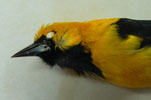
1867 - John Cassin names Icterus graceanna (White-edged Oriole) in honor of Graceanna Lewis. His description of this species is first published in the Proceedings of the Academy of Natural Sciences, Philadelphia, PA (1867, Page 52). The type specimen is part of the ornithological collection of the Academy of Natural Sciences, Philadelphia, PA
Click this thumbnail image for more information about this species
1869, January 10, 2 am- John Cassin died in Philadelphia, PA
Click this thumbnail image to see the grave site (Laurel Hill Cemetery) of John Cassin
Click this thumbnail image to see the burial card for John Cassin
Click Here to see the "Return of a Death" that is in the Philadelphia City Archives. (This is similar to what we now refer to as a "Death Certificate"
The official cause of death is listed as "Remittent Fever"
"Remittent Fever" is "A fever pattern in which temperature varies during each 24 hour period, but never reaches normal. Most fevers are remittent and the pattern is not characteristic of any disease, although in the 19th century it was considered a diagnostic term."
The actual cause of death, as listed in several places, was probably arsenic poisioning.
"Cassin's own life was dedicated to, and shortened by his love of birds. It is certain he knowingly suffered two decades of arsenic poisoning to further his knowledge. It is probably the arsenic led to his death at the age of 55. Yet John Cassin continued, in his own words, "mortgaging myself by perpetual lease to Arsenic and Liver complaint." The arsenic was contained in the mixture used to preserve the bird skins he would not stop handling. This was an era long before plastic gloves. John Cassin truly gave his life to bird study. Click Here for the full reference.
1869, April 16 -- Rachel Cassin (daughter) married Thomas Campbell Davis
After 1869
1870 US Census (First Enumeration) - August 16, 1870 - Hannah Cassin (widow), William L. (son), Rachel C. Davis (daughter), and others were living in Philadelphia.
Click Here to see an image of the full census page
1870 US Census (Second Enumeration) - Hannah Cassin (widow), William L. (son), Rachel C. Davis (daughter), and others were living in Philadelphia.
Click Here to see an image of the full census page
1872, April 23 - John Cassin's private library sold at public auction by M. Thomas and Sons (Auctioneers)
1880 US Census, June 4, 1880- William L. Cassin (son) and his wife, and others are living on Ridge Avenue, West Side, North of Springfield Avenue
Click Here to see an image of the full census page
1880 US Census, June 7, 1880 - Hannah Cassin (widow) , Rachel C. Davis (daughter), her family, and others living at 430 Spruce Street, Philadelphia, PA
Click Here to see an image of the full census page
June 23, 1888 - Hannah Cassin (wife) died. She is buried next to John Cassin at Laurel Hill Cemetery, Philadelphia PA. She was living at 1511 North 8th Street at the time of her death.
Click this thumbnail image to see the burial card for Hannah Cassin
May 1897 - William L. Cassin (son) is buried in Cassin family plot at Laurel Hill Cemetery, Philadelphia, PA
1900 - The Delaware Valley Ornithological Club founded their journal and named it after John Cassin - Cassinia
November 15, 1927 - William L. Cassin (son) removed from family plot and transferred to Westminster Cemetery
Research Projects
Any other specimens/labelsPhiladelphia City Directories - Cassin
Get dates / biblography for publications.
Civil War service - pension file has been ordered from the archives
Academy service - need to consult Academy archives
Philadelphia City Council?
Hannah Wright birth
Hannah Wright - return of death
Pictures of present day addresses
73 Union (?)
313 Union (?)
430 Spruce
Media HomesteadAcademy Buildings
Published References
Beolens, Bo and Watkins, Michael. Whose Bird?. New Haven: Yale University Press, 2003
Mearns, Barbara and Richard. Audubon to Xantus. Academic Press, London, 1992
Ruschenberger, W. S. W, M.D. A notice on the origin, progress, and condition of the Academy of Natural Sciences, Philadelphia, PA. T. K. and P. G. Collins, Printers, Philadelphia PA. 1852
Stone, Witmer. An Anonymous Work of John Cassin. The Auk. The American Ornithologists Union, Volume XXXVIII, Lancaster, PA. 1921
Weidensaul, Scott. Of a Feather: A Brief History of American Birding. New York: Harcourt, Inc., 2007
On-line References
http://www.dvoc.org/Publications/Cassina/Cassinia.htm
http://www.ilab.org/db/detail.php?booknr=357040589
http://www.philageohistory.org/citydir/MCE1856a/
http://www.philageohistory.org/citydir/MCE1857a/
http://www.philageohistory.org/citydir/MCE1858a/
http://www.philageohistory.org/citydir/MCE1861a/
http://www.philageohistory.org/citydir/MCE1866a/
http://www.tamu.edu/upress/BOOKS/1991/cassin.html
http://www.thelaurelhillcemetery.org/index.php?flash=1