• All who have an interest in birds are invited to
attend functions of the DVOC.
• Meetings are lively proceedings, with a featured
speaker or a special forum as well as reports from the various committees,
announcements, and general field notes.
• Club meetings
are held on the first and third Thursdays at 7:30 p.m. beginning the third
Thursday of September through the first Thursday in June. Unless otherwise
arranged, all meetings are held at the Academy of Natural Sciences, Philadelphia,
PA beginning at 7:30 pm. (Directions
to the Academy) Less formal summer meetings are held the first Thursday
in July, August, and September.
 January 5th, 2012
122nd Annual Members Meeting- Followed by Refreshments
|
Since the founding of our club in 1890,
the first meeting of every year has been the “Members’ Meeting.”
The meeting will feature the Annual Election of Officers and Council
members, election of Fellows, reports by the Treasurer and by the Trustees,
and other matters of interest.
Bert Filemyr
will do a short presntation on the founding of the DVOC. The presentation
is titled "From the Archives: February 3, 1890".
We will then adjourn for socializing over snacks and
drinks, organized by Bonnie and
Phil Witmer.
Click
Here for pictures from this meeting
Click
Here for a web version of the "From the Archives" presentation
Minutes of this meeting
|
January 19th, 2012
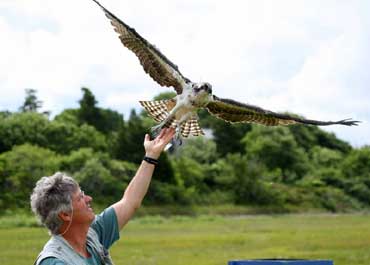
Rob Bierregaard, “Juvenile and Adult Osprey Migration between North
and South America: Routes, Timing, and Mortality”
|
|
Between 1998 and 2011 we deployed satellite
platform telemetry transmitters on 42 juvenile Ospreys in Minnesota
and in the eastern U.S. The movements of these juveniles on their first
and subsequent migrations are compared to data from 57 adults tagged
primarily before the current study. All but 5 juveniles initiated migration,
and 33 of the remaining 37 young made it at least to the Caribbean or
South America. First-year mortality of young tagged through 2010 was
71%. Mortality through 2 yrs for this cohort will be 79% (2 birds pending).
Juvenile Ospreys either migrated directly from their natal areas, with
or without exploratory excursions prior to migration, or after having
dispersed from their natal territories to staging areas, where they
settled for as long as two months. Most young started migration in early
Sept.; two did not start south until Nov. Once settled on wintering
areas, young often make looping exploratory excursions of hundreds of
km, navigating back to favored spots from novel directions. Fall migration
routes differed dramatically between adults and juveniles: 7 juveniles
from southeastern New England crossed 1,800 - 2,400 km of open Atlantic
Ocean, making landfall in the Bahamas or Cuba before moving south through
the Caribbean. No adults made this long, overwater crossing. Most young
reached the eastern end of Hispaniola before turning south. Most adults
took a shorter route from central Hispaniola to South America. We believe
the more conservative routes taken by adults are related to learning
a different route on their return north, rather than selection on young
taking more dangerous routes on their first migration.
Minutes of this meeting
|
February 2nd, 2012
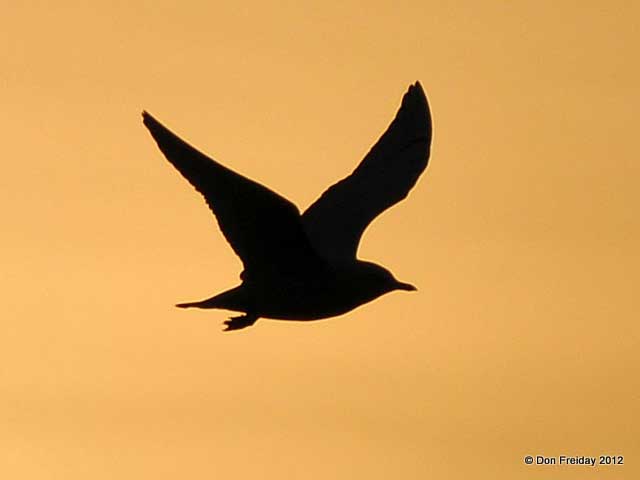
Don Freiday, "How to Identify Birds like an Expert”
| |
How do real experts in the field approach
birding, compared to the way the rest of us dolts go about it? Do they
have supernatural powers? Superior training? Greater focus? More luck?
More experience? Longer life lists? The answers are sometimes, sometimes,
always, rarely, always, and not necessarily. This is a companion program
to Don Freiday's popular, "How to MISidentify Birds Like an Expert."
Don, a Cape May birder/naturalist who shies away from the word expert
in any context, shares observations of birds and birding spanning many
years, many places, and many people, including some real experts.
Minutes of this meeting |
February 16th, 2012
Nate Rice, "Field Work in Vietnam”
| |
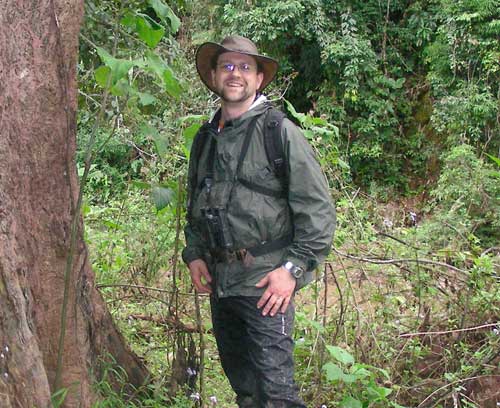
In March and April, Nate
Rice joined colleagues from the University of Kansas on a second collecting
trip to Vietnam, to the montaneregions on the border area with China
and Laos. The entire expedition was funded by the KUNHM (through a major
grant from the Center for Disease Control) tosearch for emerging diseases
(such as avian influenza) in wild bird populations. We collected nearly
100 species and over 500 specimens and were accompanied by a Herpetologist
(Charles Linkem, KU graduate student) who also collected hundreds of
specimens.
Ornithological
Moment: "Snowy
Owls: Age, Sex and Plumage" - Art
McMorris
Presentation of the 2011 Bob
Billings Big Year Award. Long-time DVOC member Bob Billings left
the club funds in his will to endow an annual award for the club member
who "recorded and identified the largest number of birds during
each prior calendar year." 2011 was the inaugural year of the competition.
The winner of the competition will be announced and the award check
will be presented to the winner.
Minutes
of this meeting |
March 1st, 2012
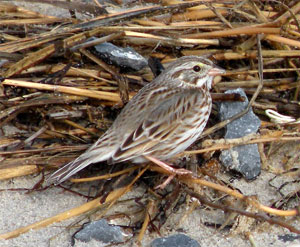
Frank Windfelder - The Fabulous Ipswich Sparrow
|
|
The Ipswich Sparrow is
a fascinating little bird whose fragile existence depends upon the fate
of a large sandbar in the North Atlantic. Join me on a magical mystery
tour through its life history. Many great photos.
Minutes
of this meeting
|
March 15th, 2012
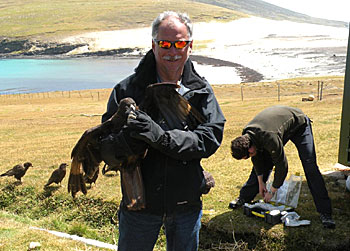
Keith Bildstein - Movement Ecology of Scavenging Birds of Prey
| |
Dr. Keith Bildstein, Director
Conservation Science at Hawk Mountain, and eminent raptor researcher
will introduce preliminary results of his work on the movement and feeding
ecology of Striated Caracaras and Turkey Vultures on the Falkland Islands,
where he has been studying these birds for the past six years. The two
species, which represent different lineages of birds of prey, offer
an intriguing comparison in life styles: Turkey Vultures are shy overall,
whereas Striated Caracaras are both bold and pathologically curious.
The caracara is also both Near Threatened globally and little studied.
Keith also will be happy to update you on other things at ‘Hawk
Mountain’.
Minutes of this meeting. |
April 5th, 2012
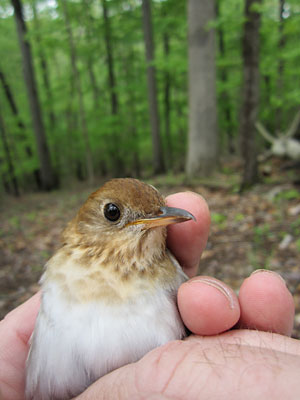
Matthew Halley - "Multiple Male Feeders at Nests of the Veery –
a new perspective on the nesting behavior of Wilson's enigmatic thrush"
| |
Two hundred
years after Wilson (1812) first described the Veery, Catharus fuscescens,
remarkably little is known about its breeding ecology and behavior.
Matthew Halley, a graduate student at Delaware State University, has
used hidden video cameras to reveal that a breeding population of Veeries
at White Clay Creek State Park, Delaware, exhibits an exceedingly rare
mode of parental care in which multiple males attend single-female broods.
Matthew will show rare video footage of Veery nesting activities while
discussing the results of his research within the context of Catharus
social evolution and behavioral ecology.
Minutes
of this meeting
|
April 19th, 2012
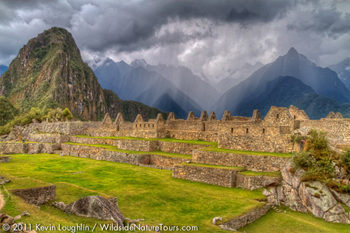
Kevin Loughlin - PERU: Birds of the Inca and Amazon
|
|
Best known for the iconic ruins of
Machu Picchu, Peru is home to nearly 2000 species of birds! Amidst rubble
from ancient Inca and pre-Inca structures we can find endemic Inca Wrens
and Green-and-White Hummingbirds. Colorful tanagers flock in the canopy
of the cloud forest and the endangered Spectacled Bear can still be
found here... with luck. Following the rivers as they flow east out
of the mountains we come to the Amazon Basin where, in Peru, the mighty
Amazon River is formed. Oxbow lakes hidden deep in the forest offer
glimpses of Giant Otters, as the unlikely Hoatzin growls and grumbles
from the tree-lined shores. Macaws and parrots color the sky with reds,
greens, yellows and blues as they flock to the clay licks. Join, Kevin
Loughlin, owner of Wildside Nature Tours, for this color-filled photographic
journey through the mountains, forests and rivers of Peru!
Ornithological
Moment - Mike Fritz: 2011
Billings Big Year
Minutes of this meeting |
May 3rd, 2012
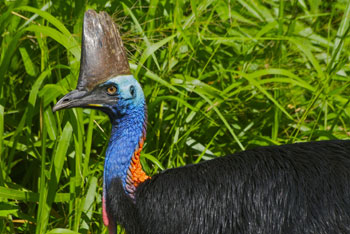
Steve Kacir, "Bush Camping and Spotlighting: A Queensland Safari"
| |
During October of 2010, Steve Kacir
joined friends Nikolas Haass and Raja Stephenson on an exploration of
Cape York and tropical Queensland. Dominating the northeastern section
of Australia, Queensland is Australia’s “Sunshine State”
and a hotspot of biodiversity with 175 species of freshwater fish, 442
species of reptiles, 120 frog species, 226 mammal species and 615 species
of native birds. Steve will share photos and experiences from this trip,
exploring the Cairns area, the Atherton Tablelands, Daintree National
Park, the Artemis Station/Musgrave Station Area, Lakefield National
Park and Cape York. Highlights from this Queensland Safari included
such birds as Southern Cassowary, Red Goshawk, Beach Stone-curlew, Golden-shouldered
Parrot, Platypus, Bennett’s Tree-kangaroo, Spotted Cuscus, Gould’s
Monitor Lizard, Coastal Taipan, Amethystine Python, Mudskipper and Spotted
Archer Fish. Join Steve to learn more about bush camping and spotlighting,
road trains and roadhouses and the incredible beauty and diversity of
northeastern Australia’s wildlife.
Minutes of this meeting |
May 17th, 2012
Edwin Scholes, "The Birds-of-Paradise Project: Revealing an Avian Wonder
of the World"
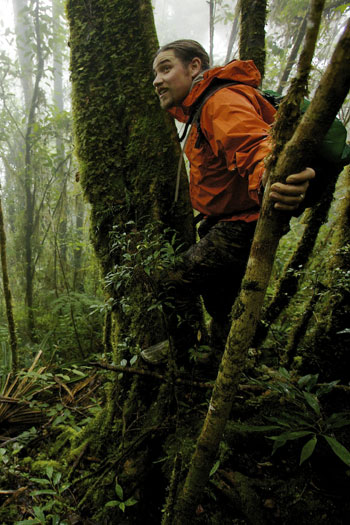 Photograph by Tim Laman
 |
For the better part of a decade, ornithologist
Ed Scholes and wildlife photographer Tim Laman have traveled over the
entire New Guinea region to observe, study and document the 39 species
of birds-of-paradise with photographs, video and audio recordings. Join
Ed Scholes of the Cornell Lab of Ornithology as he gives a sneak peek
into the conclusion of this multi-year effort that will be the subject
of a forthcoming book, museum exhibit and documentary film in late 2012.
Minutes of this meeting |
June 7th, 2012
Terry Master, "Riparian Songbirds: Canaries in an Aquatic Coal Mine"
| |
Riparian songbirds throughout the world
have distinct adaptations and characteristics in common, though they
have rarely been singled out as a discreet group of birds upon which
to focus research efforts in the manner of forest interior species,
for example. Two Pennsylvania species, the Louisiana Waterthrush (Parkesia
motacilla) and its more terrestrial counterpart, the Acadian Flycatcher
(Empidonax virescens), are both common species in their preferred hemlock-dominated
stream habitats. Each species, through its ecology and behavior, reflects
human-induced impacts to this habitat at various spatial scales ranging
from the entire watershed to local stream reaches. Thus, each species
serves as a bioindicator of riparian ecosystem health. This program
will begin broadly by describing patterns of distribution, behavior
and characteristics of riparian songbirds throughout the world and then
concentrate specifically on our two local representatives of this bird
assemblage and what they can tell us about their streamside habitats.
Ornithological Moment: Report of the 2012 DVOC World
Series of Birding Team.
Minutes of this meeting |
July 12th, 2012 (Note the date change)
Informal Summer Meeting - The Schuylkill Center for Environmental Education,
Philadelphia, PA
The Schuylkill Center for Environmental Education (SCEE)
is located in the northwest corner of Philadelphia, in the neighborhood of
Roxborough.
8480 Hagy's Mill Road
Philadelphia, PA 19128
Click Here
for directions
August 2nd, 2012
Informal Summer Meeting - John Heinz (Tinicum) NWR, PA
http://www.fws.gov/heinz/index.html
Short Presentations Including:
Debbie
Beer – The Eastwick Development Project near Heinz NWR
Cindy
Ahern – Native Plants and Wildlife (mostly birds)
|
September 6th, 2012
Informal Summer Meeting - Palmyra Cove Nature Center, Palmyra, NJ
http://palmyracove.jharte.com/default.aspx
Short Presentations Including:
Kim
Custer – “Legacy in the Making: Past, Present and
Future of Ornithology at the Academy of Natural Sciences – the
Rhoads Project”
Club member Kim
Custer, a volunteer with the Historical Society of Haddonfield
Library, while researching Boxwood Hall, a local historical site,
learned about Haddonfield's most prominent naturalist, and a founder
of DVOC, Samuel
Nicholson Rhoads (1862-1952) whose journals and papers were part
of the library’s collections. In association with the Academy
of Natural Sciences, the Historical Society decided to bring together
the specimens and the journals that reveal the details of his scientific
pursuits, the historical details of his travels and a personal perspective
of the life of an early 20th century naturalist in a way never before
accomplished. This presentation will compare the methods and practices
of Rhoads’s specimen collecting trips with current specimen
collecting trips. Before and after the meeting items there will be
on display items from Rhoads and Dr.
Nate Rice (both DVOC members) as a comparison study of 100 years
of collecting specimens for ANS.
Gadgets Galore: Birding in the
Age of Electronics; a panel discussion of the latest in apps and gadgets
for improving your experience in the field.
|
September 20th, 2012
Bert Filemyr, "Birding Oregon"
|
|
Centered around the experiences
of a June 2010 trip this program will explore the varied habitats of
central and northern Oregon. Join six birders from the Philadelphia
area as they take an eleven day trip beginning and ending in Portland
Oregon. Birding highlights included Sooty Grouse, sea bird colonies,
Red-breasted Sapsucker, Western Tanager, Hermit Warbler, Townsend's
Warbler, Barrow's Goldeneye and other specialties of the Pacific Northwest.
Minutes of this meeting |
October 4th, 2012
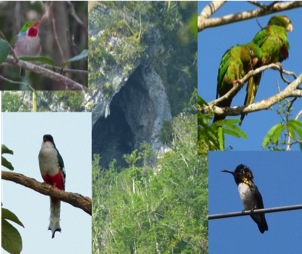
Sue Killeen, "Birding Cuba for Cuban Endemics"
| |
Over 370 bird species have been recorded
in Cuba, including 29 which are endemic to the island and 29 considered
globally threatened. Due to its large land area and geographical position
within the Caribbean, Cuba represents one of the most important countries
for Neotropical migratory birds – both birds passing through on
their way south (75 species) and those spending the winter on the island
(86 species).
Some of the birding locations we visited included the Western Mountain
ranges in Pinar del Rio best known for the tropical karstic forests
and is home to the Cuban Tody and Cuban Trogon. The Zapata Peninsula
on the southern shore of Cuba is a most important birding area that
features everglades-like ecology and is home to the Bee Hummingbird
and Zapata Wren. Our eastern most destination was the historical city
of Camaguey and the Protected Area of Sierra del Chorrillo for the Cuban
Palm Crow. Our last destination was the Northern Archipelagos of Cayo
Coco and Cayo Guillermo known for their mangrove flats, low coastal
scrub, and sandy shoreline and Cayo Paredon Grande (the northeastern-most
key in the archipelago, which is one of Cuba’s most important
migratory landfalls). It is here where you can find the Gundlach’s
Hawk.
Join Sue to see the birds of Cuba and the diversity of the island from
her trip with the DVOC in March/April 2012.
Minutes of this meeting
|
October 18th, 2012
Derek Lovitch, "How to Be a Better Birder"
| |
Curious about how the best birders
find and ID birds, especially during migration seasons? Derek Lovitch
will show us how expert birders combine time-tested field skills with
state of the art technology to become "better" birders. Using
the Sandy Point (Yarmouth, ME) morning flight phenomenon that is discussed
in Derek’s new book How to Be a Better Birder as a case study,
we will learn how geography, weather, and habitat combine to provide
outstanding birding opportunities, maximize our time in the field, and
challenge ourselves to improve our identification skills.
Minutes of this meeting
|
November 1st, 2012
Dr. Robert Curry - Advances
in chickadee hybridization: birds and methods on the move
| |
Hybridization between
Black-capped and Carolina Chickadees has been a research focus in several
laboratories for more than a decade. Our field studies in southeastern
Pennsylvania, along with new Breeding Bird Atlas results, have documented
rapid northward movement of the hybrid zone. Our current work considers
whether differences in personality between and within the species influence
hybrid zone dynamics. This research incorporates powerful new field
methods to investigate behavioral variation on multiple levels.
Minutes
of this meeting |
November 15th, 2012 - Annual Banquet!
Stephen W. Kress - RESTORING ENDANGERED SEABIRDS: LESSONS FROM PUFFINS AND
TERNS
Click
Here for the 2012 Banquet Reservation
Form!
Click
Here for more information on the banquet!
|
|
Humans have devastated
seabird colonies in many parts of the world by excessive hunting for
food and feathers and by introducing mammals such as cats and rats to
otherwise secure nesting islands.
Worldwide, 29% of all seabird species
are now globally threatened as marine pollution, coastal development
and effects of global warming are growing concerns. Although seabird
nesting islands seem safe due to their remoteness, they are intimately
connected to human activities. For example, Maine seabird nesting islands
are affected by large populations of Herring and Great Black-backed
Gulls that benefit from garbage and fisheries waste practices hundreds
of miles from nesting islands. As scavenging large gulls increase, they
deter smaller, migratory seabirds, such as puffins and terns from nesting
on many of their historic nesting islands. And ironically, other wildlife
restoration success stories such as the recovery of Bald Eagles and
Peregrine Falcons now threaten rare Maine seabirds such as Great Cormorants
and Roseate Terns.
Dr. Stephen Kress, Director of
National Audubon Society's Seabird Restoration Program, will review
how techniques developed on Maine islands have led to the restoration
of puffins and terns to historic nesting islands in the Gulf of Maine.
Dr. Kress will also discuss how techniques developed in Maine are helping
seabirds worldwide. His lecture includes reviews of several case studies
in seabird restoration including restoration of Common Murres in California
to relocation of Short-tailed Albatross off of an active volcano in
Japan and efforts to save the endangered Bermuda Petrel from rising
oceans and increased frequency of hurricanes.
|
December 6th, 2012
Members' Photography Night

| Results
of the 2012 Members' Photography Night
Birds Category:
3rd Place: Paul Guris - an action shot of a running Snowy Plover
2nd Place: Linda Widdop - a photo of a group of Black Skimmers
on a beach
2nd Place: Barrie Ashby - a close shot of a Least Bittern
1st Place: Paul Guris - a flight shot of an immature Yellow-crowned
Night-heron
Birders Category:
Honorable Mention: Steve Mattan - a shot documenting a birder’s
set up process
3rd Place: Bob Horton - a close-up of a young birder and her
telescope
2nd Place: Bob Horton - group of Boy Scouts working on Bird
Study Merit Badge
1st Place: Barrie Ashby - birders eating lunch in the rain under
umbrellas
Natural History Category:
3rd Place: Barrie Ashby - butterflies trying to get salt from
a turtle’s eyes
3rd Place: Paul Guris - a pair of Northern Raccoons in Texas
2nd Place: Marvin Hyett - mating wasps on a flower with a floral
background
1st Place: Andy Smith - some millipedes on the Appalachian Trail
Scenery Category:
Honorable Mention: Andy Smith - a band on Snow Geese against
a landscape
3rd Place: Steve Mattan - a Hawaiian volcano against a starlit
night sky
2nd Place: Steve Mattan - an exquisite 3.3megapixel shot of
the Yosemite Valley
1st Place: Andy Smith - sunset and silhouettes of birds
Best of Show:
Andy Smith - some millipedes on the Appalachian Trail
|
|
Photography has become
an integral part of birding. It’s just harder to challenge that
ID when a picture gives support. But DVOCers have turned it into an
art. All members are invited to submit photos in the categories of Birds
(maximum 5 photos), Natural History (non-avian flora and fauna; maximum
5), Scenery (3), and Birders (3). A panel of judge(s) will announce
the first, second and third place winners in each category. Prizes will
be awarded to the first-place winners, and a Grand Prize for the “Best
of Show.” Jpg digitals only, best resolution is 1024 x 768 pixels.
For each slide, include the name, location and category. Submit to Phil
Witmer by e-mail or on CD (snail mail or handed in at a meeting)
by November 22nd. Photographers give permission to
have their winning entries posted on our club website. Previously submitted
photos are not eligible.
2011
Photo Contest Winners (This is a large pdf file. Please allow it
time to load)
Minutes
of this meeting
Winners
of the 2012 Members' Photography Contest
|
December 20th, 2012
"Raptor Migration in South-east Asia" - Robert DeCandido PhD and
Deborah Allen
| |
Asia is a huge place -
from Israel in the far west to Borneo-Indonesia in the far Far East.
In this slide talk, we'll focus on recent discoveries on raptor and
bird migration in South-east Asia. Up to 26 raptor species (300,000
individuals) are known to migrate at our watch site in the bottleneck
region of southern Thailand. We have been studying migrants in both
spring and autumn since 2003. We have also documented three bee-eater
species in migration, as well as White-throated Needletail Swifts, Pacific
Swifts, Dollarbirds, Ashy Minivets - and many more. Our research and
publications have traced the annual north to south movement of raptors,
with Black Bazas and Chinese Sparrowhawks being the two most common
species we see each year. Five Accipiters are migrants here and another,
the Crested Goshawk is a resident. Most of the data from Thailand we
will present has only been discovered in the last decade. Thailand is
moving ahead rapidly in migration studies with a new $150,000 center
built at Pencil Hill (Khao Dinsor) to learn and teach about bird migration,
as well as the implementation of an extensive banding program. Our photos
will show birds in flight and close-up in the hand so you can see nuances
of plumage details. And if time permits, we will show images from some
of our research in Nepal where the largest migration of Steppe Eagles
in the world takes place - from east to west in the foothills of the
Himalayan Mountains.
For the last decade or so, Dr. Robert DeCandido
and photographer Deborah Allen have made many visits to Asia, primarily
to study bird migration. In spring 2000-01 they studied the spring migration
of birds returning to the Asian mainland (Malaysia) from Sumatra. In
2003, they spent much of the year in Eilat, Israel where they helped
band 10,000 or so birds and watch the raptor migration there. In autumn
that year, they were off to Thailand, where they helped discover a raptor
migration site of global significance. In winter/spring 2005, Bob and
Deborah spent several months in the largest preserve in Sabah, Borneo
studying the birds, insects and plants of that Malaysian state. Since
2007, they have been back and forth to Thailand, studying spring and
autumn migrant birds. Publications about Asian birds from their research
have appeared in The Journal of Raptor Research, Forktail, Ardea, and
The Journal of the Yamashina Institute of Ornithology.
Ornithological
Moment - "Falcons and Parrots: Almost Songbirds?" - Art
McMorris
Minutes of this meeting
|
Additional programs will be posted as they are scheduled.
 Academy location
 Parking location
  Informal pre-meeting dinner location (City
Garden Resturant)
Informal pre-meeting dinner location (City
Garden Resturant)
 FULL 2012 MEETINGS / PROGRAMS SCHEDULE